Moffitts Antiques
18th Century Black Basalt Bust of Rousseau in Wedgwood Style
18th Century Black Basalt Bust of Rousseau in Wedgwood Style
Couldn't load pickup availability
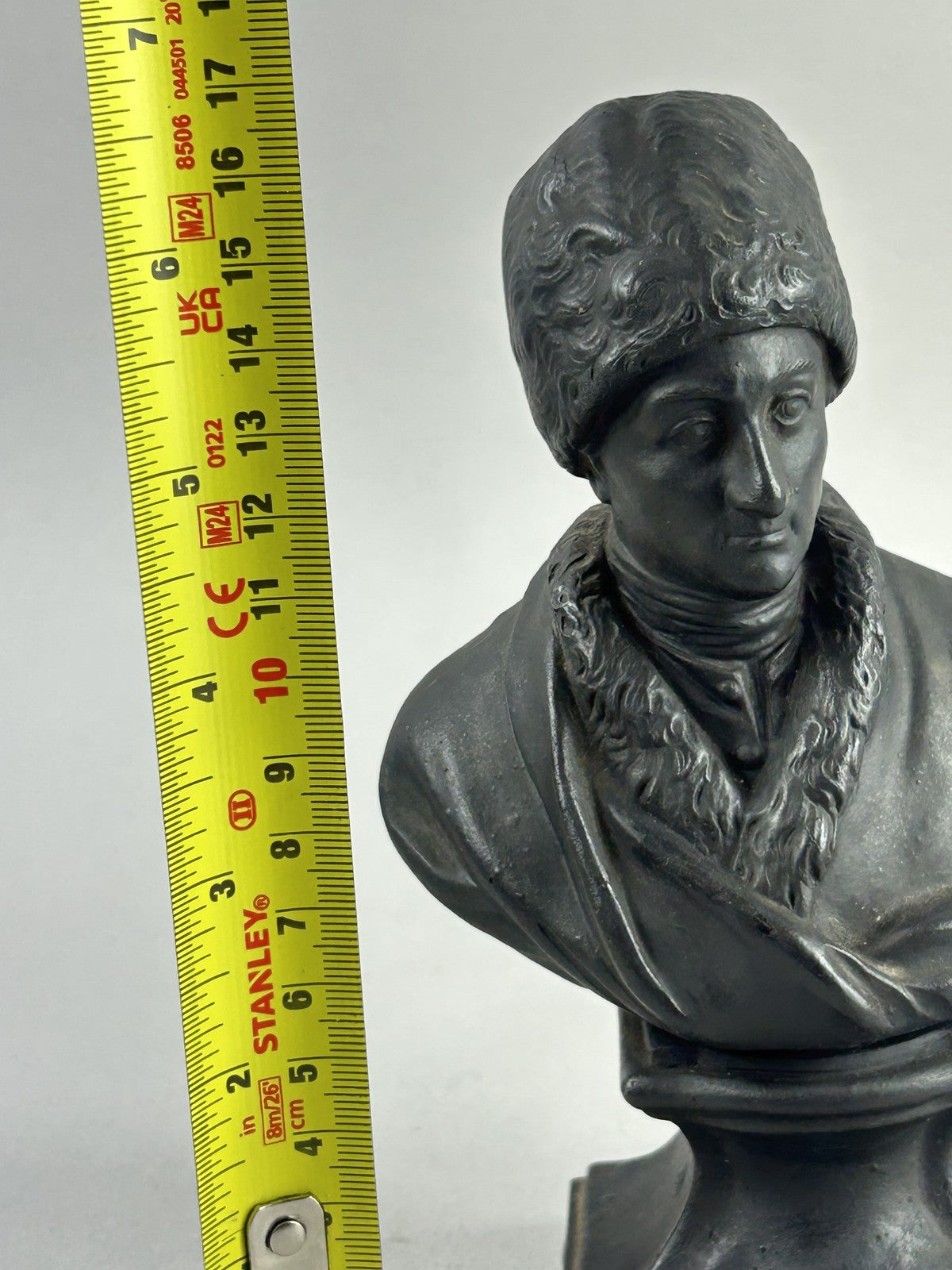
This finely modelled black basalt bust depicts the philosopher Jean‑Jacques Rousseau and is a particularly attractive example of late 18th‑century neo‑classical ceramic portrait sculpture. Standing approximately 16 cm high, the bust is worked in a dense, matte black stoneware body that closely echoes the celebrated wares of Wedgwood & Bentley, whose portrait busts of leading Enlightenment figures were highly fashionable among educated collectors from the 1760s onwards. Although this piece is unmarked by a factory, the style, proportions and finish indicate that it was almost certainly produced in the same period and very likely by a closely related English manufactory responding to the demand for Wedgwood‑type basalt portraiture.
The sitter is identified by the impressed inscription "Rousseau" to the back of the socle base. The modelling displays considerable skill: the sharply observed features of the face, the slightly downcast, reflective expression and the crisp treatment of the fur‑lined coat and soft cap capture the widely circulated contemporary likeness of Rousseau. The head is turned very slightly to one side in the classical manner, giving the bust an elegant profile from every viewing angle. The bust is set on an integral waisted socle with square plinth foot, a form that compares closely to recorded basalt busts of the same era.
The body is a true black basalt – a refined iron‑rich stoneware fired to a deep charcoal black, with a subtle graphite sheen on the higher points. As is typical of early basalt, there are scattered tiny pinholes and a few minute bubbled areas from firing, clearly visible in the close‑up images. These manufacturing quirks are consistent with 18th‑century production methods and help confirm its period nature, rather than suggesting later reproduction. The underside is flat and unglazed, again in keeping with basalt busts intended for display on mantelpieces, library shelves or in cabinet settings.
Condition is very good for a piece of this age. There is no obvious restoration or overpainting visible under normal light, and the extremities such as the tip of the nose, the front edges of the drapery and the corners of the plinth show only light rubbing and tiny surface marks from handling and display. The matte surface retains an appealing, slightly silky patina that collectors value in early basalt. Any minor imperfections, including the small firing bubbles mentioned in the notes, are to be expected in hand‑made wares of this period and do not detract from the strong visual impact.
The bust’s modest size makes it particularly versatile: at around 16 cm high it sits comfortably on a desk, bookshelf or within a cabinet of portrait miniatures and medals, and it pairs especially well with other basalt wares such as classical vases, medallions and intaglio‑style plaques. For collectors of Wedgwood and related Staffordshire stonewares, the piece offers an opportunity to acquire a scarce Enlightenment portrait in an early basalt body that bridges ceramics, sculpture and intellectual history. For interior decorators, the deep black tone and neo‑classical profile provide a striking accent in both traditional and modern schemes.
This bust will appeal to specialists in 18th‑century ceramics, Wedgwood basalt enthusiasts, and those with an interest in Rousseau and the material culture of the Enlightenment. Its combination of refined modelling, period black basalt body and clearly impressed title mark makes it a particularly desirable and comparatively rare survival from the golden age of English neo‑classical portrait bust production.