Moffitts Antiques
18th Century Worcester Porcelain Dragon Pattern Serving Dish 27cm
18th Century Worcester Porcelain Dragon Pattern Serving Dish 27cm
Couldn't load pickup availability
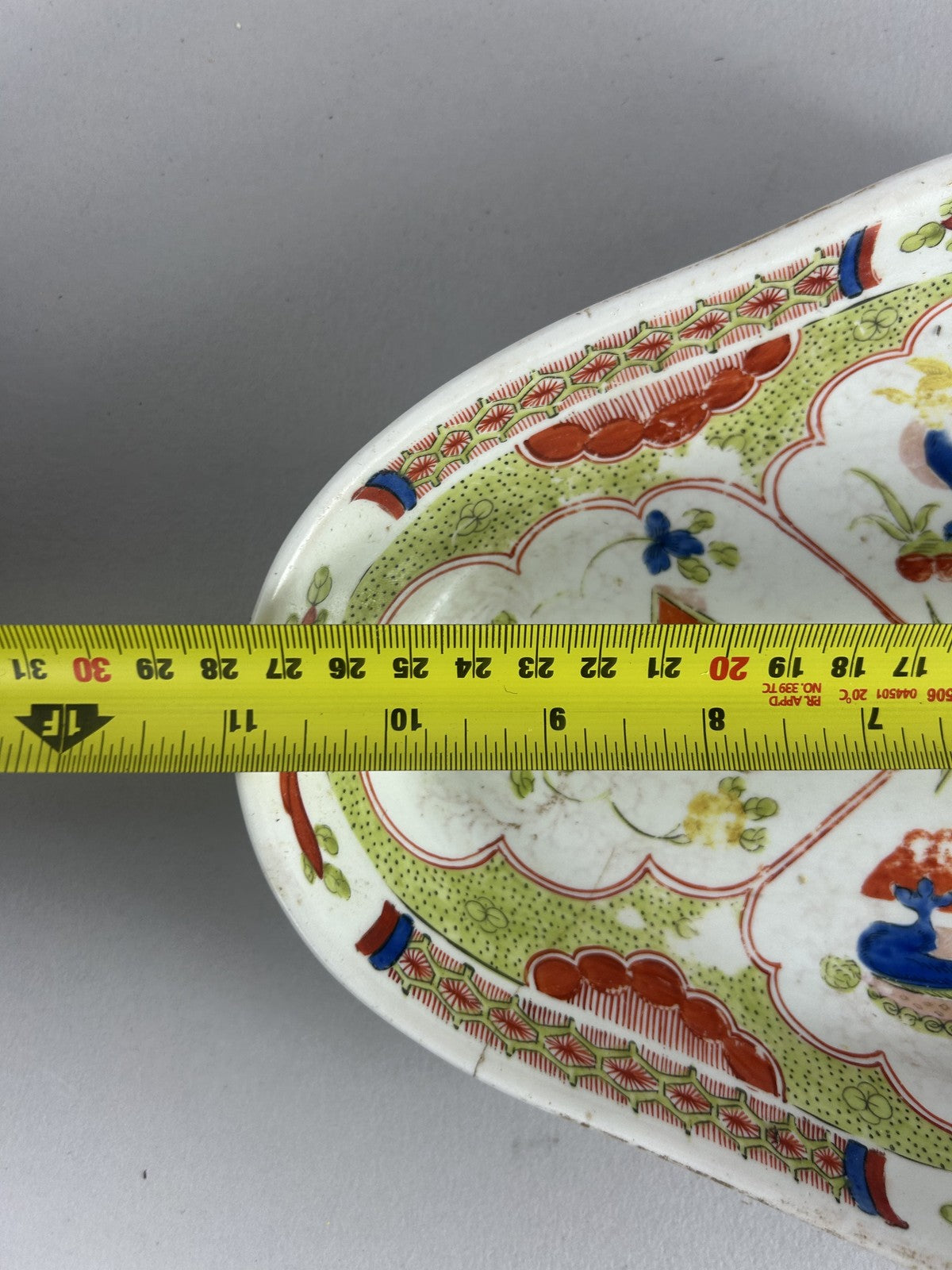
This attractive 18th‑century serving dish is a fine example of early English Worcester porcelain, decorated in a lively hand‑painted “dragons in compartments” style. Of shell‑shaped, quatrefoil outline with softly lobed sides, the dish measures approximately 27 cm in length as shown in the final image. The shallow interior is divided by red scalloped cartouches into four main panels surrounding a central medallion, an arrangement strongly influenced by contemporary Chinese export wares but interpreted here in a distinctly English palette and manner.
The central roundel features a bold eye‑like motif radiating fiery red and green rays, framed by small foliate sprays. Around this, each compartment is individually painted with bright enamel colours. Two panels contain stylised recumbent beasts or “dragons”, picked out in intense cobalt blue with green, yellow and iron‑red detailing, standing on red ground bases. The opposing compartments are filled with baroque floral and still‑life groups including blue and yellow flowers and small vases, cups and stands in red and yellow. These naïve yet confident motifs are characteristic of mid‑ to late‑18th‑century Worcester enamelling, where Chinese and Japanese sources were freely mixed with European decorative ideas.
The border is particularly eye‑catching, consisting of a lime‑green ground filled with tiny black stippling and scattered clover‑like trefoils, edged by a repeating semicircle band in iron red that echoes rococo shell scrolls. To the outer rim runs a further geometric frieze of red starbursts within a green trellis, with small cobalt and red blocks punctuating the design at intervals. All outlines are executed in a crisp iron‑red, giving the pattern clarity and movement. The enamels retain pleasing vibrancy, the blue especially strong, and the overall aesthetic is one of spirited polychrome decoration rather than the more restrained underglaze‑blue patterns more commonly associated with early Worcester.
The underside of the dish is plain, with a typical glazed footrim and no factory mark, which is consistent with many Worcester pieces of this period. The paste appears fine and relatively lightweight, firing to a slightly warm white tone under the glaze. The glaze itself shows the subtle surface wear and light scratching expected of an 18th‑century utilitarian serving piece. No restoration is evident in the photographs, and the dish presents honestly with its original surfaces intact.
Condition is generally good for an item of this age but with some notable flaws that should be mentioned for accuracy. There is a visible hairline running in from the rim, shown clearly in the close‑up images; this appears stable but should be treated as a structural crack. A small associated rim chip or flake loss can also be seen at one end, together with a few tiny frits and manufacturing imperfections around the edge. The interior well shows utensil wear and minor discolouration commensurate with use, and there is light age‑related crazing to the glaze. These issues do not significantly detract from the visual impact of the dish when displayed and are very typical of 18th‑century porcelain that has seen service on the table.
Pieces in this particular “dragons in compartments” or fantastical beast pattern are not commonly encountered, especially in this larger serving size and unusual quatrefoil shape. The combination of decorative interest, early date and relatively scarce design makes it a desirable addition for collectors of Worcester and other English porcelains of the Georgian period. It displays beautifully laid flat in a cabinet, on a stand, or as part of a group of polychrome armorial and oriental‑inspired wares. For those who appreciate the progression of English porcelain from direct Chinese copies to more individual interpretations, this dish illustrates that transitional moment perfectly.