Unbranded
Antique Spode Creamware Reticulated Two Handle Centerpiece Bowl
Antique Spode Creamware Reticulated Two Handle Centerpiece Bowl
Couldn't load pickup availability
This attractive antique centerpiece bowl is an early Spode creamware piece, distinguished by its elegant reticulated body and richly hand-painted decoration. Produced in Staffordshire, England, the bowl carries an impressed “Spode” mark and an incised workman’s or pattern letter “N” to the underside, consistent with late 18th–early 19th century production. It is an excellent display example of Spode’s refined creamware and the factory’s mastery of openwork forms.
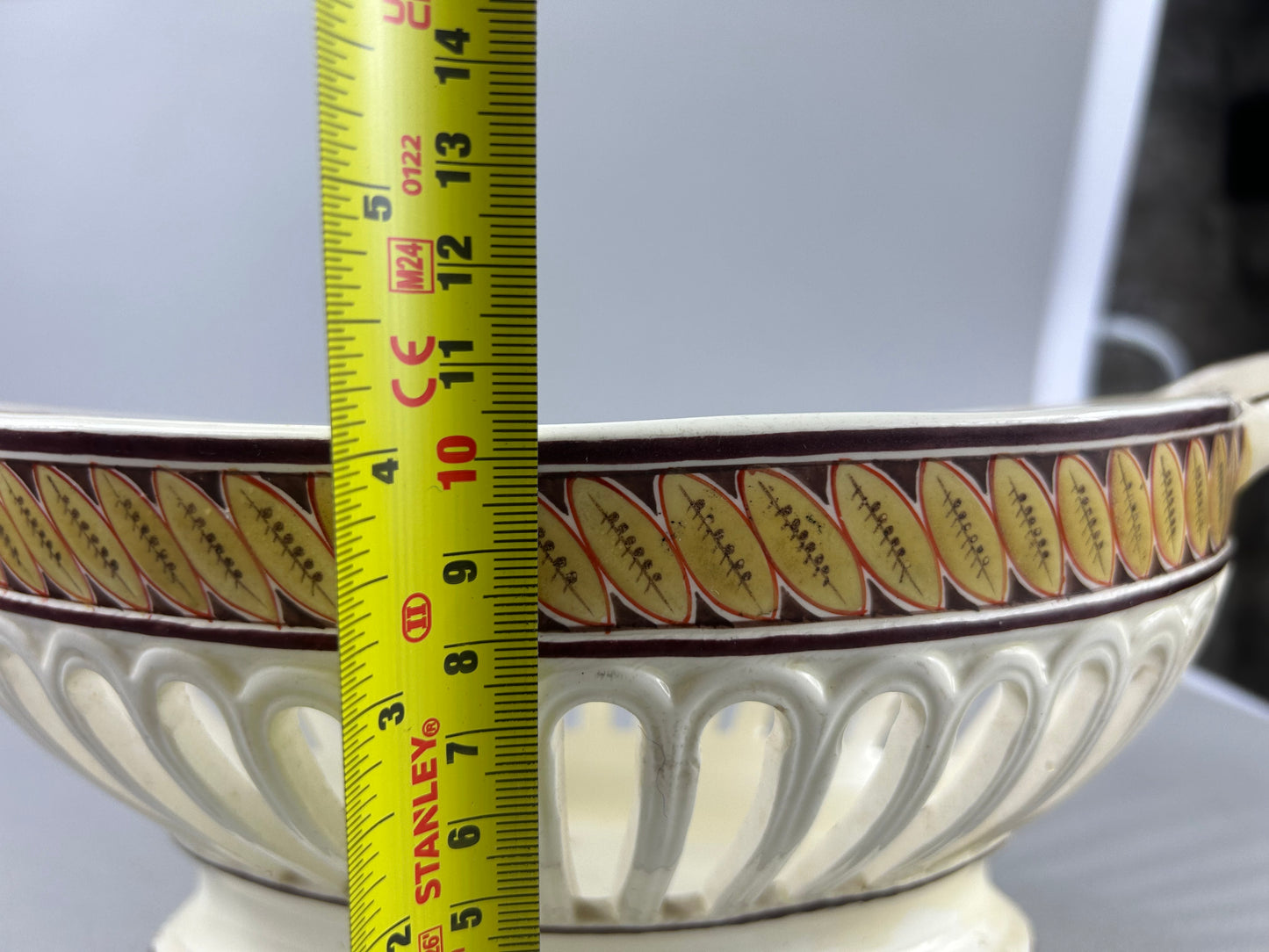
The bowl is of elongated oval shape with a gently everted rim and a waisted, slightly domed foot. On each end is an integral sweeping handle which rises gracefully from the rim and is accentuated with painted narrow brown lines. The sides of the body are fully pierced with evenly spaced upright slots, framed by moulded arcading that gives strength and rhythm to the design. This labor‑intensive reticulation is typical of the higher quality creamware baskets and centerpieces of the Georgian period and was intended for use with fruit or sweetmeats, allowing air to circulate and juices to drain.
The creamware body has the warm off‑white tone associated with early Spode, covered in a clear lead glaze that shows the subtle ripples and tiny firing specks characteristic of hand production. Around the rim runs a continuous band of hand‑painted oval panels in alternating marigold‑yellow and iron‑red, each leaf‑shaped reserve delicately picked out with a central stylised sprig in fine black line. This repeating pattern creates a vivid border that contrasts beautifully with the plain, creamy ground beneath. A deep manganese‑brown line encloses the border and is echoed as a narrow band above the reticulated section and again around the foot, adding definition to the overall silhouette.
Dimensions are approximately 29 cm in overall length across the handles and about 10 cm in height to the top of the rim, making it a practical yet eye‑catching size for the centre of a table or sideboard. The oval interior is smooth and gently dished, with the piercing confined to the sloping sides so that fruit or decorative contents rest safely in the base. From every angle the bowl casts attractive shadows through the openwork, particularly when lit from the side or placed near a window.
Condition is generally good for a piece of this age, but it does show signs of historic use and conservation. There is evidence of professional restoration to at least one handle, visible as slight differences in surface texture and retouched colour close to the junction with the rim. The restoration appears stable and has been done with care so that the bowl remains structurally sound and ready for further display. Minor age‑related wear can be seen to the painted lines and border, especially on exposed edges and the handle tops, along with small glaze abrasions and typical firing imperfections, none of which detract from its period charm. The foot shows surface wear and some discoloration from standing on various surfaces over the decades, entirely consistent with an authentic antique example.
For collectors of Spode and early English ceramics, this centerpiece offers a desirable combination of factory mark, decorative interest and technically demanding reticulated work. It would sit comfortably alongside creamware baskets, dessert services and other Georgian tablewares, or serve as a stand‑alone statement piece in a more eclectic interior. Stylistically, the crisp arcaded piercing, restrained palette and classical oval form relate closely to Neoclassical taste, making it a versatile object that harmonises with both traditional and modern schemes.
Whether used purely as a display object, filled with seasonal fruit, or incorporated into an antique table setting, this hand‑painted Spode creamware centerpiece bowl provides a tangible link to the sophistication of late 18th–early 19th century English dining culture. Its surviving original decoration, combined with sympathetic conservation to the handle, ensures it remains an attractive and usable historic piece rather than a fragile relic.