Moffitts Antiques
Antique Wedgwood Yellow Caneware Arabesque Creamer Jug 7cm
Antique Wedgwood Yellow Caneware Arabesque Creamer Jug 7cm
Couldn't load pickup availability
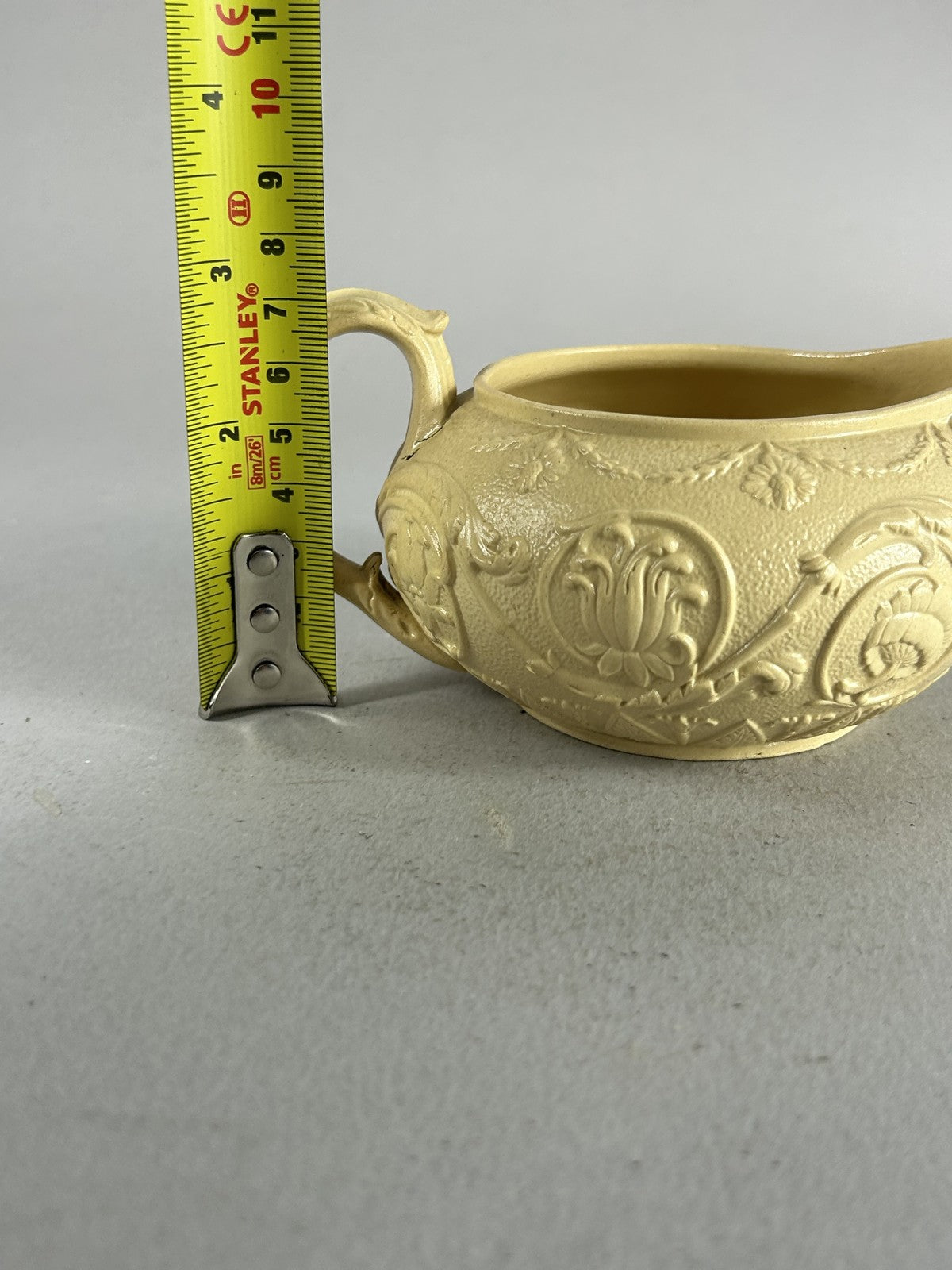
This charming antique Wedgwood creamer is a fine example of the firm’s early yellow caneware, moulded in an ornate Arabesque style and finished with the distinctive basket‑weave and foliate borders associated with mid‑19th‑century production. Measuring approximately 7 cm in height and 15 cm in length from handle to spout, it is a small yet beautifully modelled serving piece, ideal for collectors of early stoneware or as a decorative accent within a period interior.
The body is formed in a warm straw‑yellow caneware clay, left unglazed on the exterior to showcase the crispness of the relief work. The surface carries a fine pebbled ground, over which scrolling foliage, rosettes and stylised flowers are applied in high relief, creating a dense Arabesque pattern that wraps the jug in continuous ornament. Around the lower section runs a band of elongated leaves and beaded drops that subtly suggests basket‑weave, while the upper shoulder is encircled by pendant garlands and small floral bosses, all sharply modelled and typical of Wedgwood’s neoclassical vocabulary.
The jug’s low, elongated profile is particularly elegant: the body swells gently at the centre before tapering to a pointed lip, giving a smooth and well‑controlled pour. The rim is slightly everted and neatly finished, while the interior is covered with a thin, clear glaze, providing a practical, easily cleaned surface suitable for cream, milk or sauces. In contrast, the exterior remains matte, enhancing the play of light across the textured ground and highlighting the raised motifs. The handle is a shaped loop with moulded ribbing and a small acanthus terminal at the lower join, echoing the scrolling leaves in the main decoration and offering a comfortable grip despite the compact size.
To the underside, the base is recessed with a flat standing ring and shows the impressed “WEDGWOOD” mark, confirming manufacture by the famous Staffordshire factory. This straight‑line mark, together with the yellow caneware body and ornamental Arabesque reliefs, is consistent with production in the Victorian period, when Wedgwood developed a variety of decorative utilitarian wares in coloured stoneware bodies. The potting is thin and even, and the moulding is characteristically precise, reflecting the high standard of workmanship for which the firm is known.
Condition appears very good for an antique utilitarian piece of this age. The images indicate no obvious cracks or structural damage, and the spout and handle, frequent points of vulnerability, seem intact and well preserved. Minor firing specks, light surface wear and slight age‑related toning within the interior can be expected with original caneware, and they contribute to the jug’s authentic antique character without detracting from its display quality. Collectors will appreciate the overall crispness of the relief pattern, which has not been softened by heavy use or over‑cleaning.
Yellow caneware of this type occupies an interesting position between Wedgwood’s celebrated jasperware and their more everyday earthenwares. Made from a fine, hard‑fired stoneware body, caneware was prized in the 19th century for table use because it was both durable and aesthetically refined. Pieces decorated in dense Arabesque relief are particularly sought after, as they demonstrate the factory’s mastery of complex moulded ornament and reflect contemporary tastes for exotic, textile‑inspired surface patterns.
This antique Wedgwood yellow caneware Arabesque creamer would make an attractive stand‑alone display piece, especially when grouped with other examples of coloured stoneware or neoclassical ceramics. It also fits neatly into a caneware tea or dessert service, providing a functional yet decorative element on the table. Its compact size allows it to sit comfortably on a shelf, within a cabinet or on a mantel, where the warm tone and intricate modelling add subtle texture and historical interest. For collectors of Wedgwood, 19th‑century British ceramics or early stoneware tableware, this jug represents a desirable and well‑preserved example of the firm’s inventive approach to both form and decoration.