Moffitts Antiques
Doulton Lambeth 1884 General Gordon Commemorative Stoneware Jug
Doulton Lambeth 1884 General Gordon Commemorative Stoneware Jug
Couldn't load pickup availability
This handsome commemorative jug is an original late Victorian piece produced by Doulton Lambeth in 1884, created to honour the celebrated British officer General Charles George Gordon, often referred to on the jug as “Chinese Gordon”. It is executed in classic Doulton salt-glazed stoneware, with the warm biscuit-brown body contrasted by dark green and olive reliefs and a buff portrait medallion. Standing approximately 20 cm high, the jug has a compact ovoid body, slightly everted foot and a short cylindrical neck with a pinched pouring lip, all typical of Lambeth commemorative wares of the 1870s–1880s.
The exterior is richly decorated in applied and moulded relief. One principal panel carries an oval portrait medallion of General Gordon in high relief, executed in a pale stoneware that stands out crisply against a darker oval surround. Above, a raised ribbon cartouche reads “GENERAL GORDON”, while to either side sprays of laurel leaves symbolise victory and honour. The relief work is sharply modelled, indicating production in the Lambeth art department rather than a more utilitarian line.
Textual inscriptions, another hallmark of Doulton’s commemorative issues, are arranged in raised lettering across the remaining sides of the jug. One face is headed by a scroll inscribed “CHINESE GORDON” and sets out key milestones in his career: “BORN JAN. 28. 1833 – CRIMEA 1855–6 – LEADER OF THE EVER VICTORIOUS ARMY – CHINA 1860”. Opposite, a further ribbon cartouche reads “GOVERNOR GENERAL OF THE SOUDAN 1877,” above the pious motto “BY THE HELP OF GOD I WILL HOLD THE BALANCE LEVEL – KHARTOUM 1884.” These inscriptions not only date the piece firmly to the period of Gordon’s Sudan campaigns, but also encapsulate the Victorian view of him as a Christian hero and imperial martyr.
The neck and strap handle are embellished with impressed four-petalled floral motifs picked out in a darker glaze, a decorative touch frequently found on Lambeth stonewares of this date. Additional small applied devices—fans, winged emblems and foliate sprays—are placed strategically around the inscriptions, providing both visual balance and a subtle reference to Gordon’s Far Eastern service. The rim and foot are finished in a treacly dark brown glaze, framing the lighter body tone and giving the jug a pleasing visual weight.
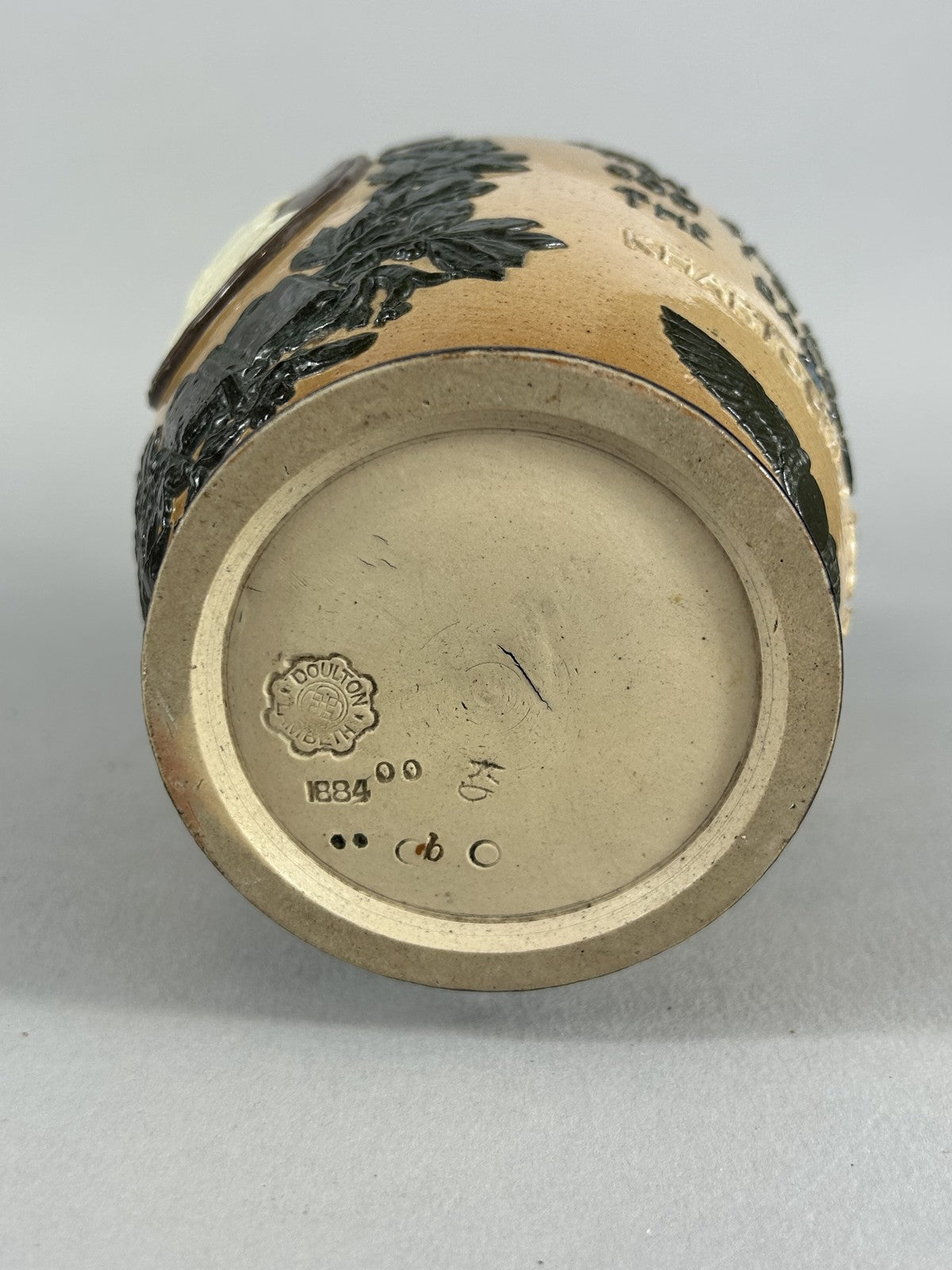
The underside bears a clear impressed circular Doulton Lambeth mark together with the incised date “1884” and associated potter’s and decorator’s monograms and tally marks. This factory mark and date are consistent with documented Doulton Lambeth production and confirm the jug as an authentic 19th‑century original rather than a later reproduction. The salt-glaze surface shows the typical fine orange‑peel texture and tiny speckling of Lambeth stoneware, while the relief elements retain good definition, indicating that the moulds were still relatively fresh at the time of pressing.
Commemorative jugs of this type were produced in limited numbers to mark topical events and personalities and would have been sold as display pieces rather than everyday tableware. The subject of General Gordon is particularly evocative: created in the year of the siege of Khartoum, this jug reflects both contemporary public fascination and the patriotic sentiment surrounding his actions in the Sudan. Today, such pieces are of considerable interest to collectors of Doulton Lambeth, British military memorabilia, and Victorian political ceramics.
In terms of condition and collectability, examples retaining sharp relief, legible inscription, and an undamaged spout and handle—as illustrated here—are especially desirable. The combination of precise dating, strong provenance through the factory marks, and historically resonant subject matter makes this Doulton Lambeth General Gordon jug a significant and decorative addition to any collection of 19th‑century British stoneware or commemorative ceramics.