Unbranded
Early 19th Century British Porcelain Teapot with Gilt Floral Border
Early 19th Century British Porcelain Teapot with Gilt Floral Border
Couldn't load pickup availability
This attractive early 19th century British porcelain teapot is a fine example of Regency period design and hand decoration, combining an elegant profile with a richly coloured enamel and gilt palette. The body is of oval form with a gently domed, conforming cover and a distinctive looped handle, all raised on a shallow foot. Measuring approximately 27 cm in overall length and 16 cm in height, it offers a pleasing, practical size while remaining highly displayable in a cabinet or on a tea table.
The teapot is made of a bright white porcelain typical of high‑quality English production of the early 1800s, and it has been entirely hand painted. Around the shoulder of the pot and repeated on the lid runs a broad pale blue enamel band, framed by fine red line borders and edged with hand‑applied gilding. Within this blue ground is a continuous garland of stylised red flowers, each picked out with a white centre, linked by fine, feathery gilt foliage and scattered gilded dots. The delicacy of the fern‑like leaves and the confident, rhythmic scroll of the vine suggest the work of an experienced decorator working in one of the better Staffordshire or provincial London workshops of the period.
The lower body and inner areas of the lid are left predominantly white, allowing the enamel and gold borders to stand out with strong contrast. Further bands of gilding accent the rim of the pot, the upper and lower edges of the body, and the footrim, unifying the design. The upright spout is neatly modelled with a gentle curve and is embellished with a gilt feather or leaf motif that runs from its base towards the tip, where the lip is finished with a gilt line; this decoration is echoed on the shoulder opposite the spout, visually balancing the form. The handle is another highlight, with its pronounced S‑shape and a small spur at the lower join, the whole outlined in gilding that has worn very little for the piece’s age.
The cover sits securely within the gallery of the pot and is surmounted by a simple yet elegant knop, again edged with gilding. The border on the lid mirrors that of the body, ensuring a harmonious appearance when the teapot is displayed complete. Vent and strain holes under the finial indicate that the pot was designed for practical use, consistent with early 19th century tea wares when tea drinking remained a central social ritual.
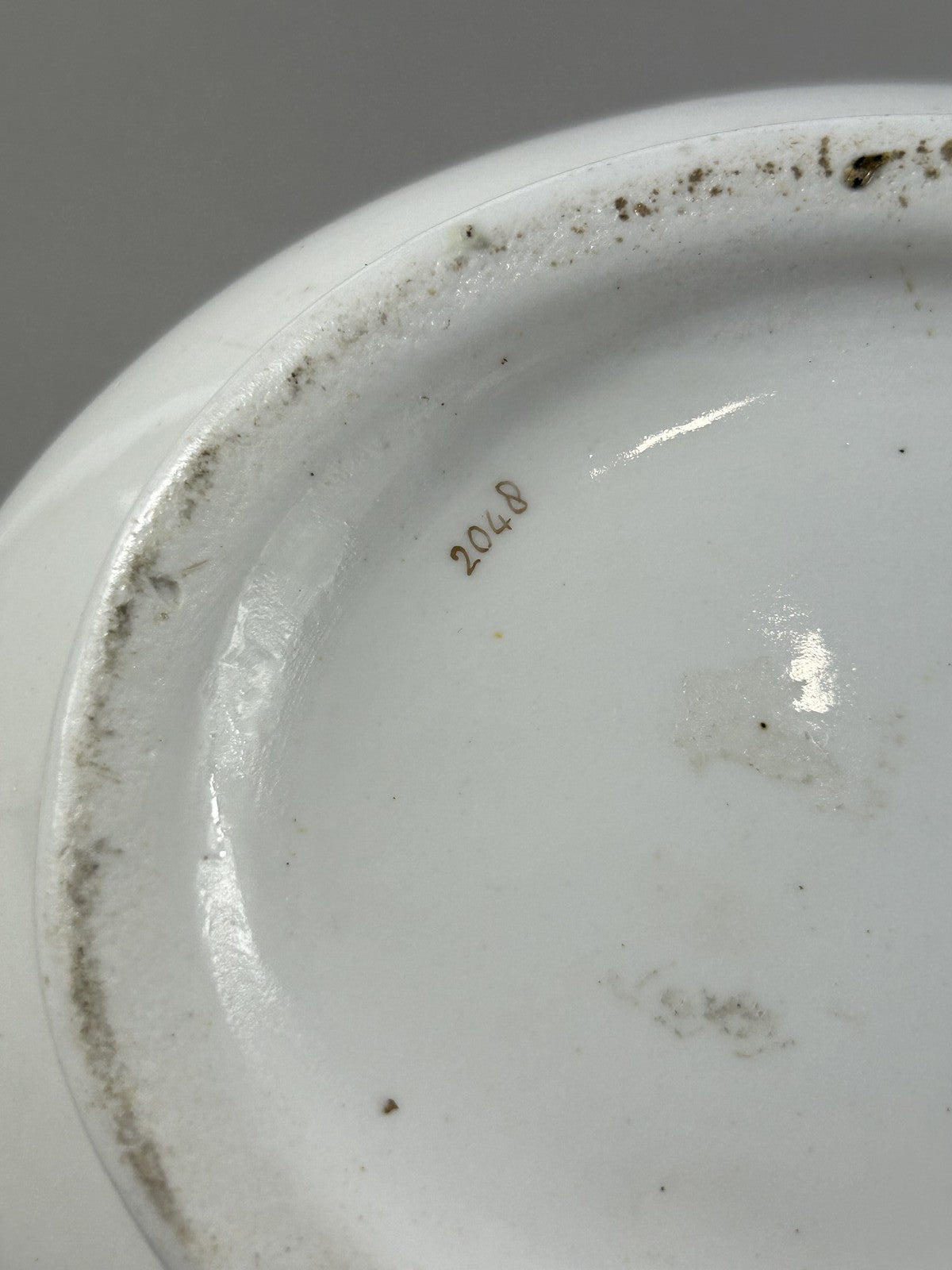
To the underside of the base is a hand‑painted pattern number, “2048”, executed in iron‑red enamel. This type of numeric mark is characteristic of many English factories of the 1810–1830 period, where pattern books recorded decorative combinations for use across tea and dessert services. While no factory name is present, the quality of the paste, the shape of the handle and spout, and the refined style of gilding closely align with pieces produced by better Staffordshire and London makers in the Regency era. The unglazed footrim shows the expected ring of age‑related wear from table contact, lending additional reassurance of authenticity.
Condition is described as good throughout and, from inspection of the photographs, appears commensurate with age and use. The enamel colours remain bright and unfaded, the blue ground clean and even, and the red floral motifs retain their depth of tone. Gilding to the rims, handle and spout shows only light rubbing at the high points, notably to the tip of the spout and top of the knop, in line with gentle historical use rather than later restoration. No obvious chips, cracks or hairlines are visible, and there are no signs of major over‑painting, which is important for collectors seeking pieces in honest condition. The interior appears clean, suggesting careful use, and the lid fits well without noticeable rocking.
This teapot would appeal to collectors of early English porcelain, especially those focusing on the Regency period, hand‑painted floral borders or numbered pattern series. Its graceful silhouette and lively red and blue palette make it a strong decorative accent in both traditional and contemporary interiors. It would display beautifully alongside matching cups and saucers, or as a stand‑alone statement piece in a cabinet of mixed British wares. For reference, the approximate dimensions are 27 cm from handle to spout, and 16 cm to the top of the finial. The combination of well‑preserved gilding, crisp hand painting and a clearly legible pattern number “2048” enhances both its desirability and its research potential within the broader context of early 19th century British porcelain manufacture.