Moffitts Antiques
Early 19th Century English Imari Style Lion Finial Tureen
Early 19th Century English Imari Style Lion Finial Tureen
Couldn't load pickup availability
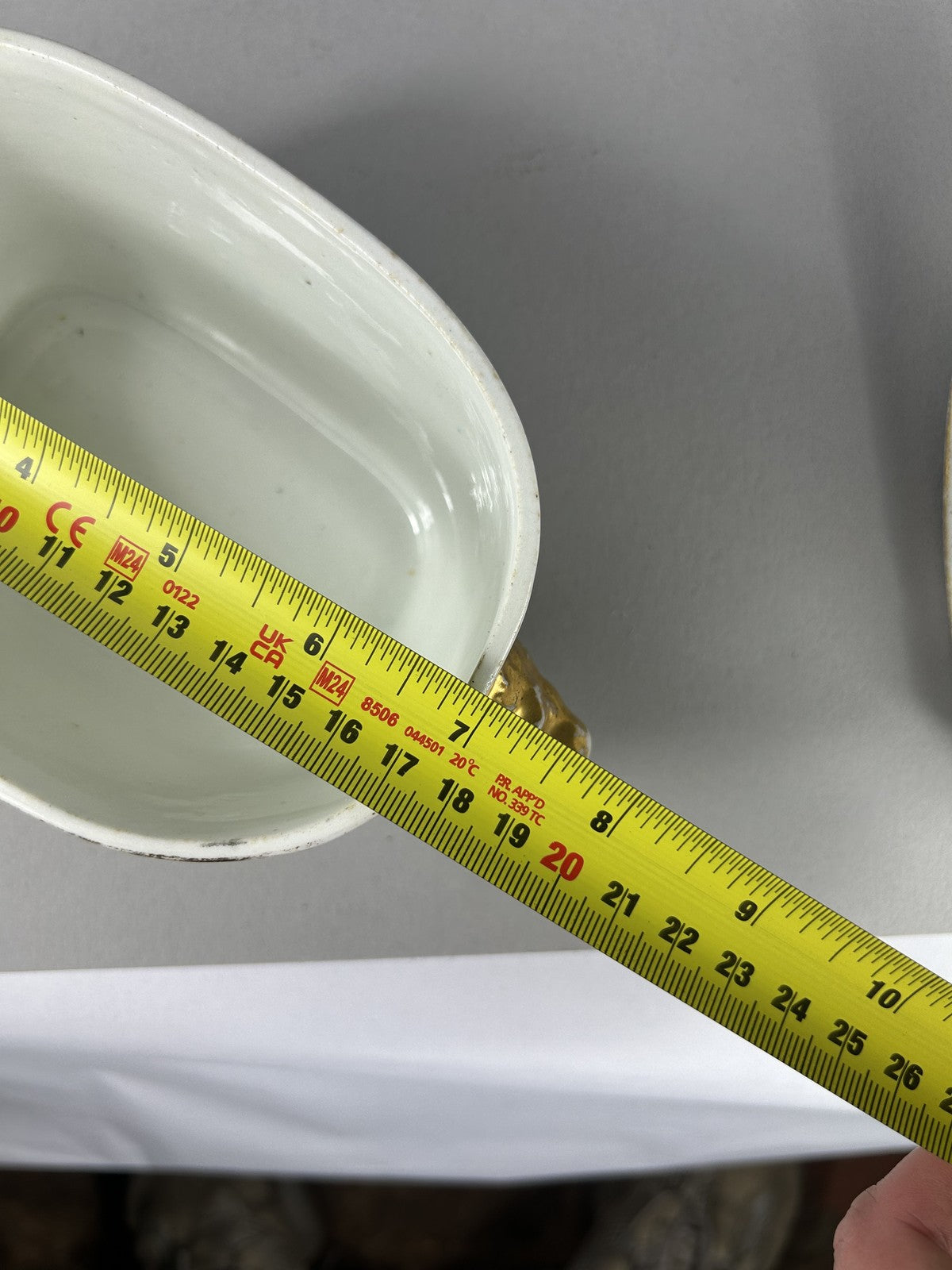
This charming small covered tureen is an early 19th-century English porcelain piece, very much in the Regency taste, and decorated in a brilliantly coloured, loosely Imari-inspired palette. Measuring approximately 20 cm across the handles, it is a compact but richly ornamented serving vessel that would originally have formed part of an elegant dessert or supper service. The oval body stands on an integral, moulded foot and rises in gently convex sides, the shoulders swept up to receive the corresponding domed cover. The overall form is typical of British porcelain of c.1815–1830, combining neoclassical symmetry with a playful menagerie of applied ornament.
The most striking feature is the gilt lion finial which surmounts the lid. Modelled in the round, the recumbent lion is richly picked out in burnished gilt, now softly rubbed on the raised areas through age and handling, revealing the white porcelain beneath. This sculptural knop not only provides a functional grip for removing the lid but also proclaims strength and heraldic dignity, a recurring motif in English decorative arts of the period. Echoing this theme, each end of the tureen is fitted with a moulded lion’s head handle, also lavishly gilded, giving the vessel a bold zoomorphic presence on the table.
The ground of both body and cover is a clean, slightly bluish porcelain white, enlivened with dense hand-painted enamelling. The decoration is arranged as a continuous garden of stylised flowers and foliage, dominated by large composite blooms in orange, iron-red, yellow and puce, with reserves of deep cobalt blue leaves heightened with fine gilt veining. Scattered green leaves, pink blossoms and small orange florets fill the remaining spaces in a free, almost exuberant manner that contrasts with the more formal Japanese Imari prototypes yet clearly draws inspiration from them. Fine trailing tendrils in gilt add sparkle and visually link the floral groups, while the raised moulding under the enamels provides an attractive sense of texture.
The tureen has a shaped notch to one side of the cover, indicating that it was intended for use with a ladle, suggesting a function for sauces or relishes rather than soup. The interior is plain glazed, with the same hard, bright early porcelain typical of British factories of the period. The unmarked base and slightly greyish glaze on the underside are consistent with a number of regional English makers active in the first quarter of the 19th century, including Staffordshire and possibly early Derby or Coalport-related concerns. In the absence of a factory mark, the attribution remains stylistic, but the combination of lion finial, colourful overglaze enamels and gilt detailing is entirely in keeping with contemporary English production.
Condition is a significant factor with this piece and should be clearly noted. Both the cover and body have been extensively but competently restored; visible in the photographs are multiple radial cracks to the lid and body, filled and overpainted, including an area of more obvious repair at the lower rim on one long side. The underside of the lid shows a network of consolidated fractures, and there is some associated discolouration along the join lines. Gilding to the finial, handles and decorative details is rubbed and locally re-touched. Minor fritting and roughness to the footrim and inner rim are present, consistent with age and use. Despite these issues, the tureen presents well on display, the busy pattern and bright palette successfully distracting the eye from much of the restoration.
For collectors, this small tureen offers an attractive example of early 19th-century English porcelain tableware that illustrates the period’s fascination with Oriental-inspired ornament interpreted in a distinctly British, Regency manner. Its lion finial and handles provide strong sculptural interest, while the colourful flowers and gilt enrichments epitomise the decorative exuberance of the time. Although heavily restored and priced accordingly, it remains a decorative and historically engaging object, suitable for inclusion in a cabinet of early porcelain, a study collection of English Imari-style wares, or as a conversation piece within an interior that values patina and the visible passage of time.