Moffitts Antiques
Early Engine Turned Black Basalt Coffee Jug with Female Finial, c.1800
Early Engine Turned Black Basalt Coffee Jug with Female Finial, c.1800
Couldn't load pickup availability
This finely potted early black basalt coffee jug is an elegant example of late 18th–early 19th century English neoclassical ceramic design, clearly inspired by the wares of Josiah Wedgwood but almost certainly produced by a smaller contemporary manufactory. Standing approximately 24 cm high to the top of the finial, the jug is wheel‑thrown in a dense black basalt stoneware body and then finished on the lathe to achieve its distinctive engine‑turned surface.
The form is slender and well balanced, with a gently swelling baluster body rising from a slightly stepped circular foot. The sides are decorated overall with evenly spaced vertical flutes produced by engine turning, creating a subtle play of light across the matt black surface. A simple moulded cord around the waist emphasises the division between lower body and shoulder, while a narrow raised moulding just beneath the rim gives additional crispness to the profile.
The domed cover repeats the same fluted turning as the body, so that lid and jug read as a harmonious whole. At the summit of the lid sits a beautifully modelled seated female figure used as a finial. She is wrapped in drapery with hooded cloak, arms folded, and her pose recalls classical personifications and sentimental figures found on late Georgian basalt and jasper wares. The detail of the modelling – especially the folds of the robe and the sensitively rendered face – demonstrates a high level of skill and adds considerable sculptural interest to what would otherwise be a strictly utilitarian vessel.
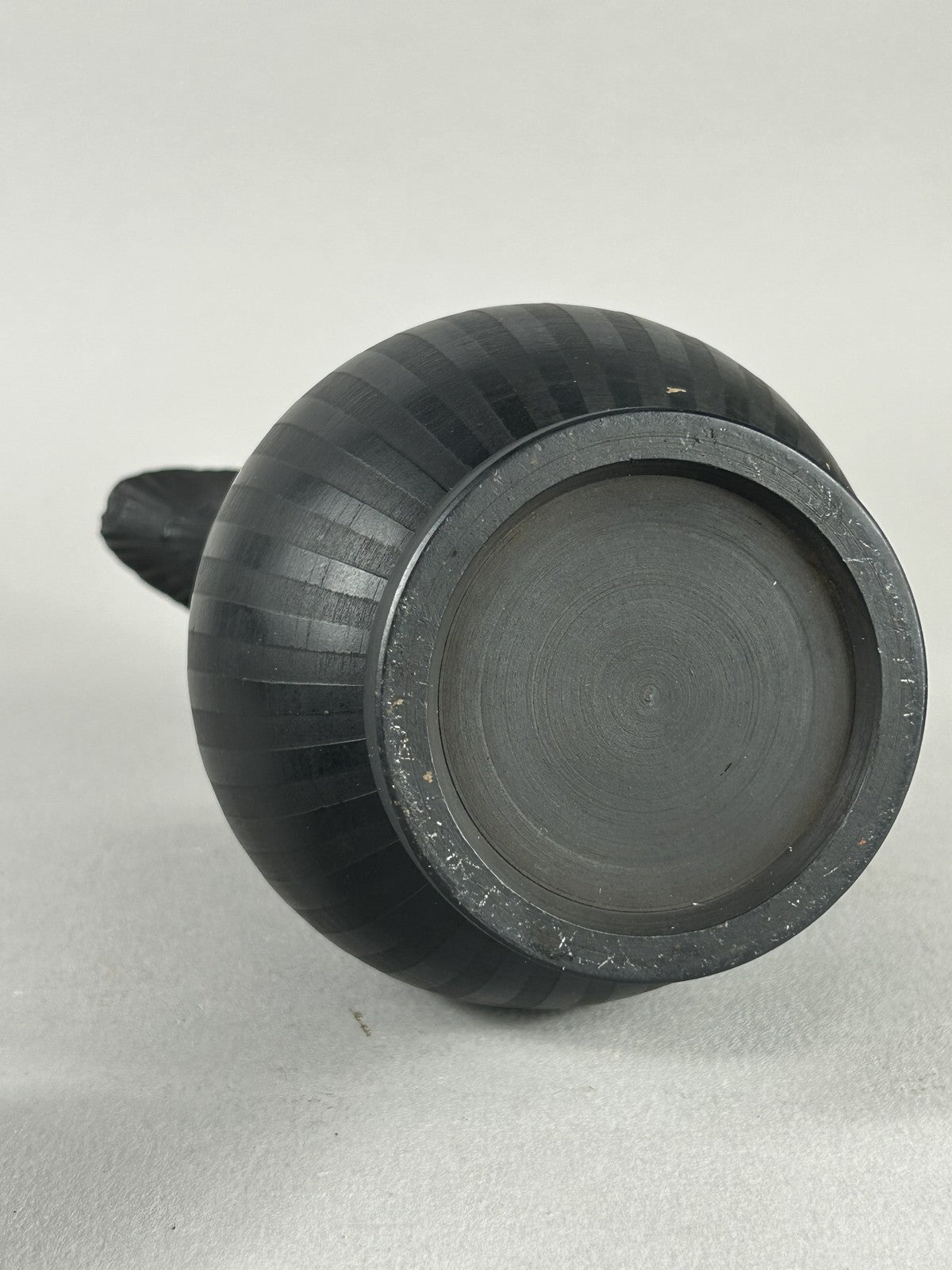
The spout is boldly scrolled and shell‑moulded, with acanthus and stylised leafage sweeping down onto the body in pronounced relief, a decorative flourish that offsets the more restrained engine‑turned ground. Opposite, the looped handle is sinuously shaped with a thumb rest at the top and a foliate terminal where it joins the lower body, again echoing Wedgwood’s neoclassical idiom. The interior of the jug is unglazed, as is usual for basalt stoneware, and the base is flat with concentric turning rings but no factory mark, consistent with early production.
Condition is generally good for an example of this age and fragile form, though there are some points to note. There is a chip and associated short hairline at the rim adjacent to the handle, shown clearly in the close‑up images, and a further small chip to the edge of the spout. Minor rubbing, light surface scratching and tiny firing specks are present commensurate with age and use, but there is no structural restoration visible under normal inspection. The cover sits well and the figure finial remains intact with only slight rubbing to the high points of the modelling.
This coffee jug displays all the hallmarks collectors seek in early basalt: sharply turned decoration, a rich charcoal‑black body with a dry, silky sheen, and a sophisticated neoclassical silhouette. The unusual use of a full figure as a finial, rather than the more common knop, makes it a particularly striking piece for display. It would complement any collection of Wedgwood and related black basalt wares, Georgian coffee and tea equipage, or early British stoneware more broadly, while also serving as an instructive example of the technical and aesthetic possibilities of engine‑turned basalt in the decades around 1800.