Moffitts Antiques
Early Royal Crown Derby cobalt & gilt soup plate c.1810
Early Royal Crown Derby cobalt & gilt soup plate c.1810
Couldn't load pickup availability
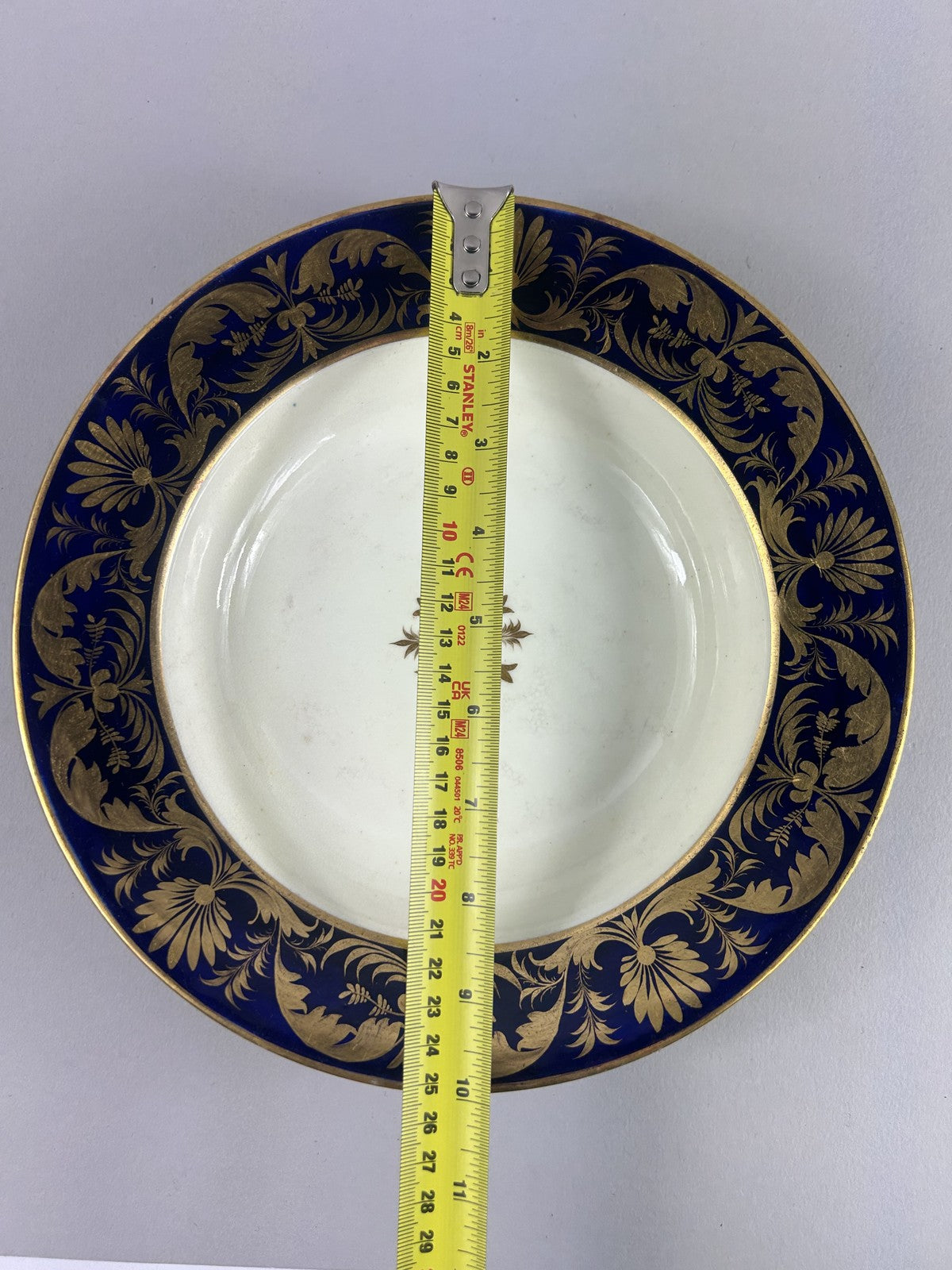
This impressive early nineteenth‑century soup plate is an attractive example of Regency period Royal Crown Derby production, dating to approximately 1806–1825. Made in fine English porcelain and measuring around 25 cm in diameter (as confirmed by the tape measure in the images), it combines a generously dished centre with a broad, richly decorated rim, making it ideal as a display piece or as part of a period table setting.
The plate is decorated in a classic Derby palette of deep cobalt blue and burnished gilt. The wide rim is entirely reserved for a continuous band of stylised foliate ornament in raised gilding, the scrolling leaves and formal flowerheads forming an elegant neoclassical border. The cobalt ground is a strong, even midnight blue, providing a dramatic contrast to the bright gold leaf and to the creamy white of the central well. A narrow inner gilt line frames the bowl of the plate, while the outer edge is finished with a gilded band that neatly defines the profile and protects the rim visually.
To the centre of the well is a finely executed gilded rosette, echoing the formal leaves and palmettes of the border. The overall effect is refined but opulent, entirely characteristic of the early Crown Derby style favoured in the Regency period, when richly gilded services were supplied to aristocratic and royal clients. The plate’s relatively deep well indicates that it was intended for soup or entrée courses rather than as a flat dinner plate.
The underside is glazed in a clear, slightly bluish porcelain glaze, with a shallow footrim that shows appropriate wear for an early nineteenth‑century piece. A small hand‑painted red mark appears near the centre of the base, consistent with early Derby factory marks of the period between about 1806 and 1825; it is applied overglaze and in the typical iron‑red enamel used at the factory. The footring exhibits light abrasion and some kiln speckling, again typical of hand‑made porcelain from this era.
Condition, based on the photographs provided, appears structurally sound with no obvious major cracks or restoration visible to the naked eye. There are scattered small surface marks and minor discolouration to the well, together with expected wear to gilding on the high points of the rim from nearly two centuries of handling and stacking. The gilded border, however, remains largely intact and still presents very well. Collectors should rely on the close‑up images for a precise assessment of glaze scratches, tiny firing imperfections and any small rim nibbles or kiln marks that may not be mentioned individually.
This piece would appeal to collectors of early Royal Crown Derby, Regency ceramics and English gilt‑ornamented porcelain. It displays well on a plate stand, but could also form part of a matched or mixed dinner or dessert service in cobalt and gold. Its generous size, early date and bold classical decoration make it a striking and decorative example of high‑quality English porcelain from the first quarter of the nineteenth century.