Moffitts Antiques
Early Staffordshire Silver Lustre Philosopher Inkstand with Four Pots
Early Staffordshire Silver Lustre Philosopher Inkstand with Four Pots
Couldn't load pickup availability
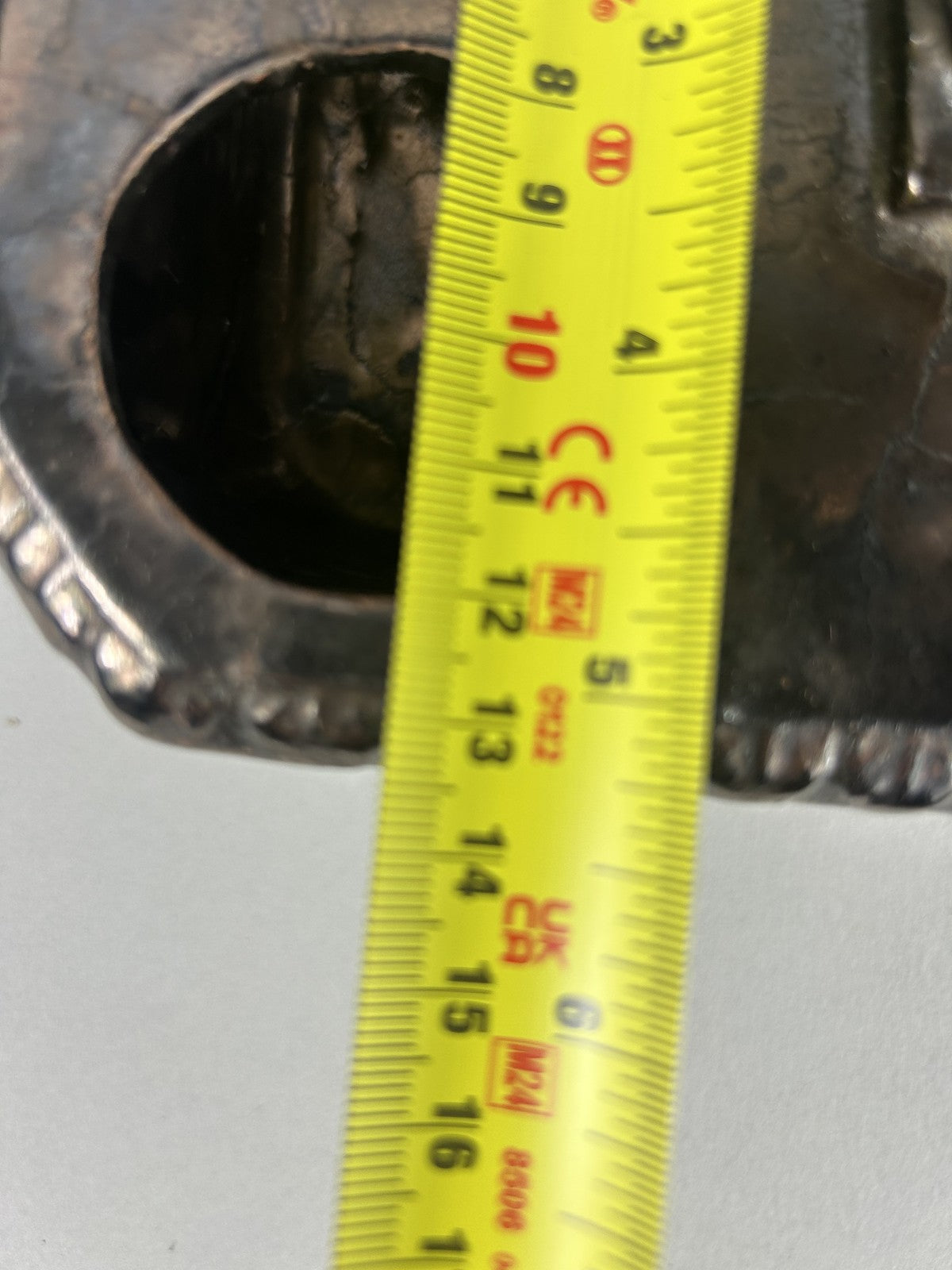
This striking silver lustre inkstand is an early Staffordshire ceramic, modelled as a classical philosopher and dating from the early to mid-19th century. The piece is conceived as a rectangular sarcophagus‑shaped base on four paw feet, surmounted by a bust of a bearded philosopher and fitted with four removable ink pots. At approximately 13 cm high, 20 cm wide and 20 cm deep, it makes an impressive yet practical desk piece and an excellent example of early Staffordshire lustreware.
The base is crisply moulded with narrow vertical fluting to all sides, framed by a slightly projecting moulded rim. The upper edge is finished with a gadrooned or scalloped border that catches the light and enhances the metallic lustre. Each corner terminates in a robust paw foot, a popular Regency and early Victorian motif that conveys both weight and stability. The underside shows the typical buff earthenware body of early Staffordshire and the pooling and wear of the original glaze, together with the firing scar in the centre of the base.
To the top of the stand sit four circular apertures housing the original ceramic ink pots. These pots are individually thrown and glazed, with a stepped ring moulding at the lip. One is pierced with multiple small holes to act as a pen rest or quill holder, while the others are left open to function as ink wells or water pots for diluting ink and washing nibs. All four inserts retain their original silver lustre finish, now beautifully mellowed through use. The design reflects an early 19th‑century writing set, providing multiple inks or colours for a well‑equipped desk.
The central feature is the finely modelled bust of a philosopher, likely intended to evoke a classical figure such as Socrates or a generic “Ancient Sage.” The head is heavily bearded with deep‑set eyes and curling hair, the shoulders draped in a simple classical cloak. The bust rises from a square socle with turned stem, integral with the lid surface. There is a drilled aperture in the top of the head and a corresponding hole in the stand, suggesting it may originally have accommodated a metal quill, feather plume, or small taper holder, adding further function and drama to the piece.
The silver lustre decoration is typical of early Staffordshire production, imitating expensive solid silver and Sheffield plate. Over the buff earthenware body a dark ground glaze has been applied and then finished with a highly reflective platinum‑type lustre, now showing attractive patination. Under magnification the glaze displays a dense network of age‑related crazing. This is expected on early lustreware and helps to confirm age. In certain areas, particularly around the edges, feet, and high points of the bust, the lustre has thinned from handling, revealing warmer bronze‑brown tones beneath and contributing to a pleasing antique surface.
The piece does show several firing and age‑related flaws, fully consistent with early 19th‑century Staffordshire manufacture. Fine firing cracks are visible on the sides and top surface, especially around the ink well apertures and across the glazed panels of the base. These appear stable and non‑structural, the cracks being sealed beneath the original glaze rather than later damage. Small chips and roughness can be seen to three of the paw feet and around some rim edges, again largely confined to the glaze and not detracting significantly from display. The removable pots exhibit minor nibbles and wear to their rims, entirely typical for working inkstands of this date.
Despite these honest signs of age and use, the inkstand retains strong visual impact. The bust remains sharply modelled and expressive, the paw feet are intact, and the fluted sides of the base are crisp. All four original inserts survive, increasing the rarity and desirability of the object; many comparable examples have lost one or more pots over time. The lustre still reads as a dark, almost gunmetal silver, particularly dramatic under directional light, with the reflective bust providing a central highlight.
As an early Staffordshire lustreware inkstand, this piece sits at the intersection of decorative and functional ceramics. It speaks to the Regency fascination with the classical world and to the emerging industrial potteries’ ability to supply fashionable objects at accessible prices. For collectors of Staffordshire, of writing paraphernalia or of early 19th‑century decorative arts more broadly, it offers a distinctive and evocative example with strong sculptural presence and authentic period wear.