Unbranded
French Creil Creamware Charger “Entrée du Lycée Bonaparte” c.1820
French Creil Creamware Charger “Entrée du Lycée Bonaparte” c.1820
Couldn't load pickup availability
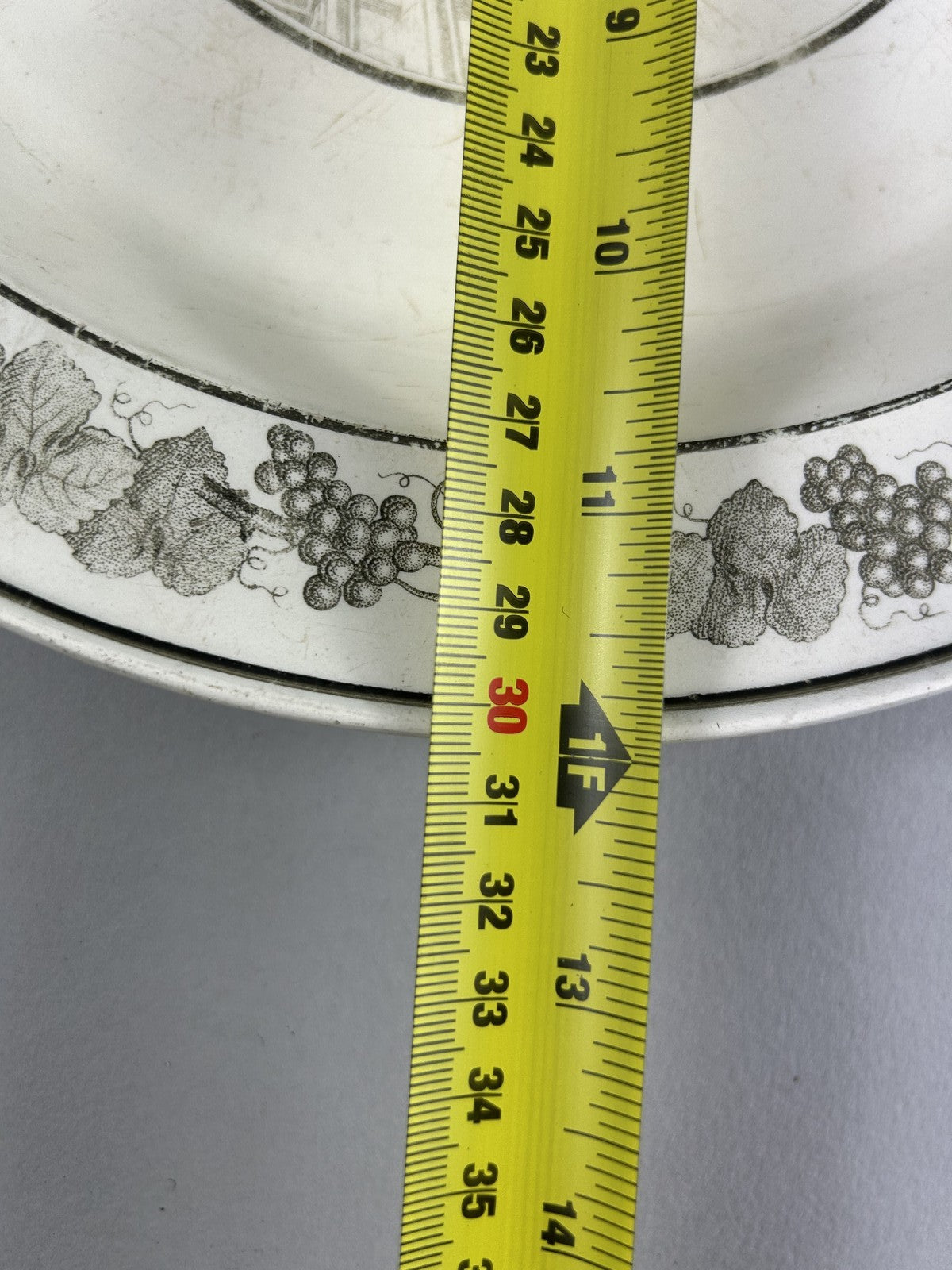
This impressive French creamware charger was produced by the celebrated Creil faïencerie in the early 19th century and is a fine example of French printed earthenware with historical topographical decoration. Measuring approximately 30.5 cm in diameter, the piece combines neoclassical form with a crisply engraved black transfer print, illustrating a significant Parisian educational institution of the Napoleonic era.
The broad rim is decorated with a continuous grapevine border, composed of densely shaded vine leaves, tendrils and heavy bunches of grapes, printed in an attractive grey‑black tone. This restrained but richly detailed ornament is typical of Creil’s early transfer‑printed services, where English-inspired decorative schemes were adapted to French taste. A narrow double-line band emphasizes the inner edge of the rim and frames the deep central well.
To the centre is a finely detailed architectural view titled “ENTRÉE DU LYCÉE BONAPARTE, Ci-devant Cloître des Capucins”, numbered “26” in the print. The scene shows the interior court and arcaded façades of the former Capuchin cloister, later converted into the Lycée Bonaparte, with two small figure staffage adding scale to the composition. The precision of the line work and the slight colour softness suggest an early Creil copper‑plate transfer, carefully adapted from a contemporary engraving.
The underside carries the black printed circular factory mark associated with the partnership period, together with an impressed “CREIL” mark, confirming production at the Creil works in the Oise region. These marks place the charger firmly in the first half of the 19th century, around the Restoration period, when the factory was renowned for its cream-bodied earthenware decorated with monochrome historical and topographical subjects for the bourgeoise table.
Condition is commensurate with age and use. The glaze on the front shows an even network of utensil scratches and light surface wear typical of a charger that has seen service at table. There is a small but visible chip to the outer rim, clearly shown in the photographs, exposing the buff body beneath the glaze. The rim chip is structurally stable and could be professionally restored if a more pristine display appearance is desired. No hairline cracks or repairs are evident to the body, and the charger rings reasonably well when lightly tapped, indicating good structural integrity. The reverse shows expected age-related staining and scuffs from contact with surfaces.
With its substantial 30.5 cm (12 in) diameter, this piece works equally well as a wall display plate or as the centrepiece of a table setting devoted to early 19th‑century French ceramics. Collectors of Creil, Saint‑Amand, and other northern French faïence fine will appreciate the clarity of the transfer, the presence of both printed and impressed marks, and the historically interesting subject referencing the Lycée Bonaparte and the reuse of monastic architectural spaces after the Revolution.
This charger would make an excellent addition to a collection of Napoleonic‑era ceramics, printed wares, or architectural views on pottery. It also offers an attractive decorative accent for an interior with classical or French provincial furnishings, providing both visual appeal and a tangible link to the educational and urban history of early 19th‑century Paris.