Moffitts Antiques
Meissen style porcelain two handled floral bowl with applied roses
Meissen style porcelain two handled floral bowl with applied roses
Couldn't load pickup availability
This attractive two handled bowl is a finely potted example of Meissen-inspired porcelain, modelled with a lobed, fluted body and richly decorated with both painted and applied floral ornament. The body rises from a slightly spreading circular foot to a gently waisted profile, finishing in a shaped and scalloped rim whose softly undulating outline enhances the light-reflecting quality of the glaze. Around the sides, the vertical fluting is crisply moulded, giving the vessel a rhythmic, melon-like segmentation characteristic of 18th and early 19th century Continental forms, particularly those associated with Meissen and its followers.
On the main face of the bowl a bold bouquet of hand-painted summer flowers forms the principal decorative panel. A striking orange-red tulip, rendered with confident, feathery brushwork, dominates the composition, supported by a yellow daisy-like bloom, smaller purple and white flowers and delicate green foliage. The enamel palette, featuring clear yellows, mauves, greens and iron-reds, recalls the naturalistic flower painting popular in Saxon porcelain from the mid-18th century onwards, where individual garden specimens were carefully observed and freely arranged across the surface.
Smaller scattered sprigs and single blooms are distributed around the remaining panels, ensuring that the bowl is visually interesting from every angle. These secondary sprays, painted in a looser but still meticulous manner, help to balance the richer main bouquet and provide continuity between the decorated and undecorated sections of the piece.
A particularly charming feature is the pair of twig-form handles, modelled as naturalistic, horizontally projecting boughs that loop at the centre to create practical grips. At the junction of each handle with the bowl, finely modelled applied flowers and leaves form small relief clusters. These include white blossoms and lilac-tinged roses, their petals delicately shaped and individually defined. This combination of applied floral ornament and painted flowers is a hallmark of Meissen rococo taste and was widely imitated by other European factories wishing to evoke the same sense of opulence.
The interior of the bowl is left plain, save for the smooth white glaze that extends over the entire surface, while the underside reveals a simple ring foot and a blue underglaze factory mark resembling a stylised “T”. Although clearly produced in the Meissen manner, this mark and the slight differences in body and glaze suggest a later Continental manufacture rather than Meissen itself, making the piece an interesting study for collectors of Meissen-style wares and for those interested in the diffusion of Saxon design across Europe.
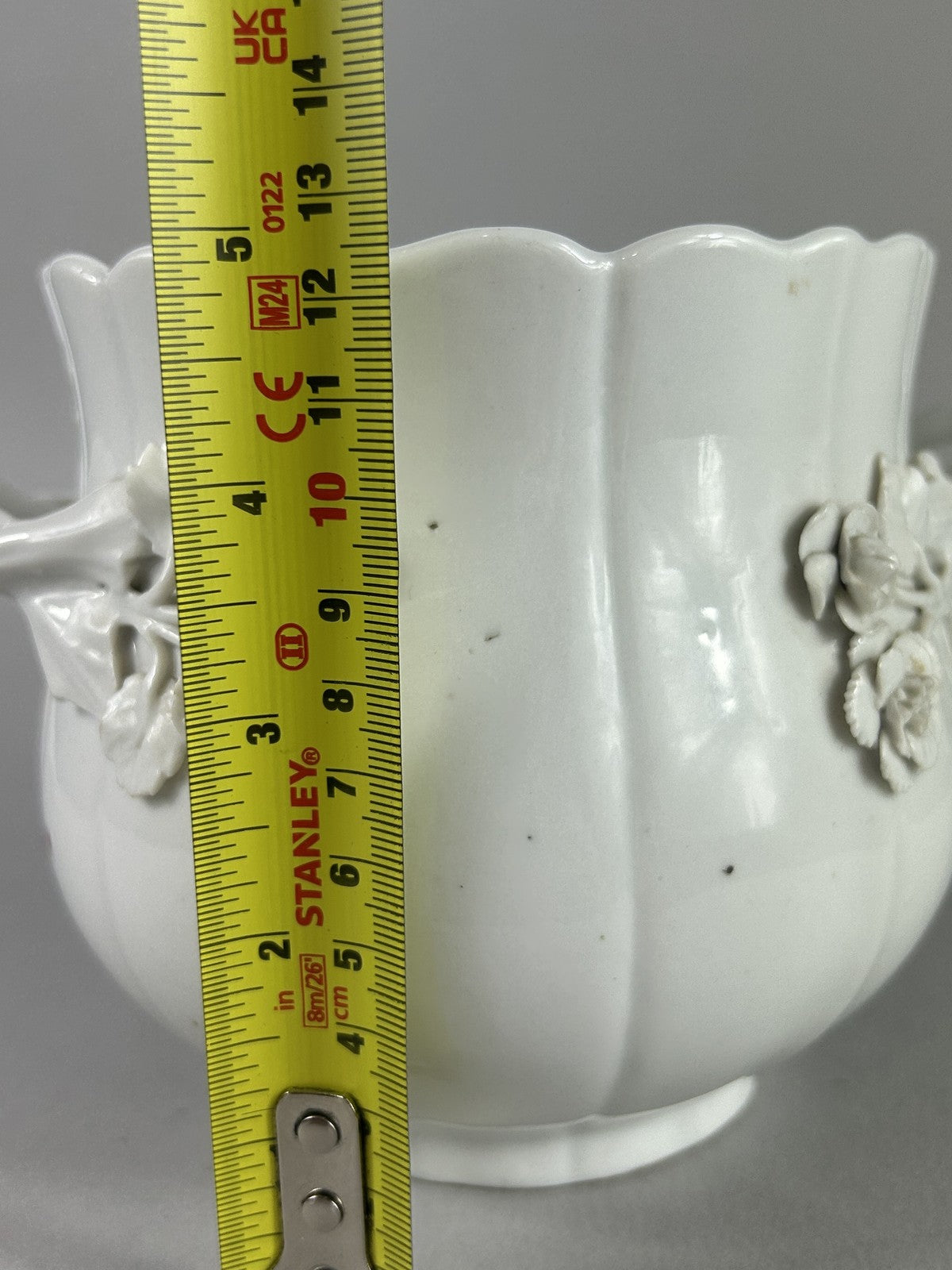
Measuring approximately 12 cm high and about 16 cm across the handles, the bowl is of a convenient size for a variety of uses: it may originally have served as a small pot-pourri container, sugar bowl, or decorative cachepot for a modest floral arrangement. Today it functions equally well as a cabinet display piece, its three-dimensional flowers and bright enamels catching the light effectively on an open shelf or within a glazed vitrine.
Condition appears generally good from the images, with the usual minor firing specks and tiny glaze imperfections expected in porcelain of this age. Collectors will value the combination of moulded flutes, applied blooms and freehand flower painting, all executed in a style firmly rooted in the Meissen rococo tradition. Whether displayed alone or alongside genuine Meissen and related Continental porcelains, this two handled bowl offers an accessible and highly decorative example of the enduring appeal of 18th-century floral porcelain design.