Moffitts Antiques
Rare Leeds Black Basalt Portrait Medallions, Set of Five c1780–90
Rare Leeds Black Basalt Portrait Medallions, Set of Five c1780–90
Couldn't load pickup availability
This framed ensemble presents a scarce and highly decorative set of five black basalt portrait medallions attributed to the Leeds Pottery, dating to the late 18th century, circa 1780–1790. The medallions are finely moulded in low relief and set within a period-style glazed frame, offering an elegant and ready-to-hang display for collectors of early English ceramics and neoclassical portraiture.
The medallions are executed in a dense black stoneware body commonly described as “black basalt”, a material popularised in England in the second half of the 18th century. Leeds Pottery is best known for its creamware, but a limited output of black basalt wares is recorded and surviving examples are markedly rarer. The present group shows the smooth, matt surface and crisp modelling associated with quality basalt production; the dark, even firing contrasts strongly against the rich golden ground of the mount, enhancing the silhouettes of each bust.
Each oval medallion carries a profile portrait bust in classical style, with inscriptions in small capitals impressed beneath the truncation of the busts. These include both male and female figures, wearing contemporary late‑18th‑century dress but treated in a manner influenced by Roman imperial coins and Renaissance medals. The detailing of the hair, drapery and costume remains surprisingly sharp for the age, with minimal softening of the high points. The legends, though partially obscured in places, are still legible enough to reward close inspection and research; these inscriptions invite comparison with known series of political and intellectual portrait medallions produced in Britain at this date.
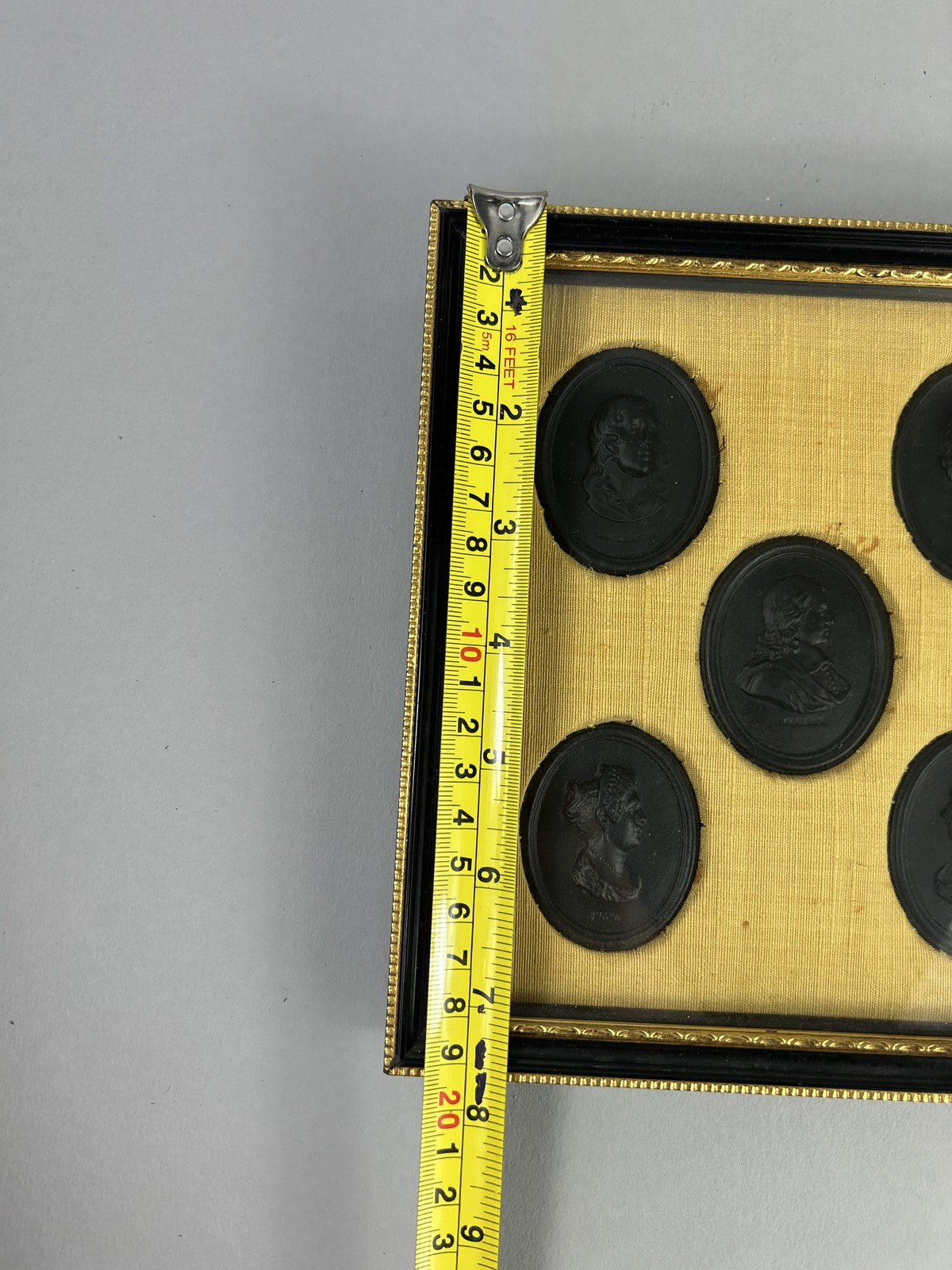
The five medallions are arranged symmetrically: one at each corner and a central piece, all fixed against a ribbed golden-yellow fabric ground that appears to be an early, if not original, mounting. The frame itself measures approximately 19 cm by 18 cm overall, as confirmed by the tape-measure photograph. It is a rectangular, moulded frame in black with a gilt inner slip, beaded outer edge and simple hanging loop to the top, presenting the group as a unified decorative panel that sits comfortably on a wall or within a larger display of ceramics and works of art.
The reverse of the frame retains an old backing board annotated in ink, reading “Marked Leeds black basalt reliefs. c.1780–90.” A small inspection aperture has been cut in the board to reveal part of the impressed pottery mark, supporting the Leeds attribution. While such handwritten labels are not definitive proof on their own, the combination of body, style, lettering and the period assessment is entirely consistent with late‑18th‑century Leeds production, and comparable medallions are recorded in museum and specialist collections.
Condition is described as good for all medallions, and this is borne out by visual inspection. There are no obvious cracks, chips or restorations to the ceramic plaques visible through the glass; the edges show only the light wear expected from age and mounting. The basalt surfaces exhibit minor incidental rubbing and traces of dust but retain a pleasing, even tone. The fabric ground shows some age-related discolouration and small pulls where the medallions are seated, together with a few scattered spots, all typical of an 18th- or early 19th-century mount that has not been over-restored. The frame displays light wear and small scuffs to the corners yet presents very well, with the gilding still bright and complementary to the black of both frame and medallions.
Historically, portrait medallions of this type were collected as intellectual and patriotic objects, often depicting statesmen, writers, scientists or classical worthies. Their format reflects the Enlightenment interest in physiognomy, biography and commemoration, and they were commonly displayed in groups like this, echoing the arrangement of cameos or intaglios. Surviving sets in black basalt from Leeds Pottery are noticeably scarcer than comparable works from Wedgwood, and framed ensembles of five matching portraits are particularly desirable for today’s collectors.
For the specialist in English ceramics, this group offers not only an attractive decorative object but also a valuable document of Leeds’ experimentation with basalt wares in the late Georgian period. For the interior decorator or private collector, the strong contrast of black reliefs against a golden ground within a neat 19 × 18 cm frame provides a compact yet striking wall accent that harmonises readily with both traditional and modern schemes. The rarity, condition and completeness of the set make it an excellent candidate for inclusion in a focused collection of 18th‑century portrait medallions or Northern English pottery.