Moffitts Antiques
Rare Staffordshire Assyrian Revival Stoneware Jug c.1855
Rare Staffordshire Assyrian Revival Stoneware Jug c.1855
Couldn't load pickup availability
This rare mid‑19th‑century British jug is a fine example of the Assyrian Revival taste that swept through Victorian design in the 1850s. Produced in Staffordshire between about 1851 and 1860, the small yet sculptural piece stands approximately 14 cm high and is moulded in a pale, matt stoneware body with crisply defined relief decoration. Its unusual archaeological subject matter, compact scale and distinctive maker’s mark to the base combine to make it a highly desirable item for collectors of early Victorian art pottery and neo‑classical wares.
The jug has a bulbous lower body rising from a slightly spreading foot, the base encircled by a band of pointed, almost chevron‑like motifs which echo Near Eastern architectural ornament. Above this, the main body is enriched with an all‑over pattern of moulded tasselled cords, arranged in a diamond trellis and tied by ringed bosses, recalling both luxurious textiles and harness ornament seen in contemporary engravings of ancient Mesopotamian reliefs. This ground of repeating pattern forms a richly textured surface that contrasts with the smooth, undecorated areas of the neck.
The central decorative focus is an Assyrian winged bull, or lamassu, rendered in low relief on either side of the jug. The hybrid creature, with its powerful bovine body, feathered wings and bearded human head, was widely popularised in Britain after the publication of Austen Henry Layard’s excavations at Nineveh in the 1840s and the subsequent display of monumental lamassu in the British Museum. Here, the potter has miniaturised the imposing guardian figure to fit the modest proportions of the jug, yet preserves key iconographic details such as the tiered curls of the beard and the strong, blocky legs, set against what appears to be a stylised stepped ziggurat or city gate.
The upper section of the jug is bordered by a frieze bearing pseudo‑cuneiform characters interspersed with rosettes linked by bead‑and‑reel moulding. Rather than attempting a literal transcription of ancient script, the designer uses simplified wedge‑shaped strokes to evoke the look of cuneiform, capturing the Victorian fascination with newly deciphered Near Eastern writing. The undulating rim, with its irregular, banner‑like profile, further emphasises the impression of an inscribed architectural cornice wrapped around the vessel.
The handle is especially sculptural, beginning as an arching strap which splits and flows down the back of the jug, the lower terminal modelled as a cloven hoof that plants itself firmly on the shoulder of the body. This zoomorphic ending subtly reinforces the Assyrian theme, echoing the powerful limbs of the lamassu figures. The handle’s generous curve and pronounced thumb rest suggest that, despite its small size, the jug was intended to be functional, perhaps for cream, sauces or spirituous liquors, although its elaborate relief work also makes it entirely suitable as a purely decorative cabinet piece.
The stoneware body is an even off‑white to very pale grey tone, with a fine speckling typical of mid‑Victorian Staffordshire industrial stoneware. The finish appears unglazed or at most very lightly coated, designed to allow the sharp moulded details to remain crisp and to emulate the appearance of carved stone or archaeological fragments. This matte, almost sculptural surface aligns the jug with contemporary Parian and biscuit wares, yet its denser body and slightly granular texture identify it more closely with stoneware than with true porcelain or bone china.
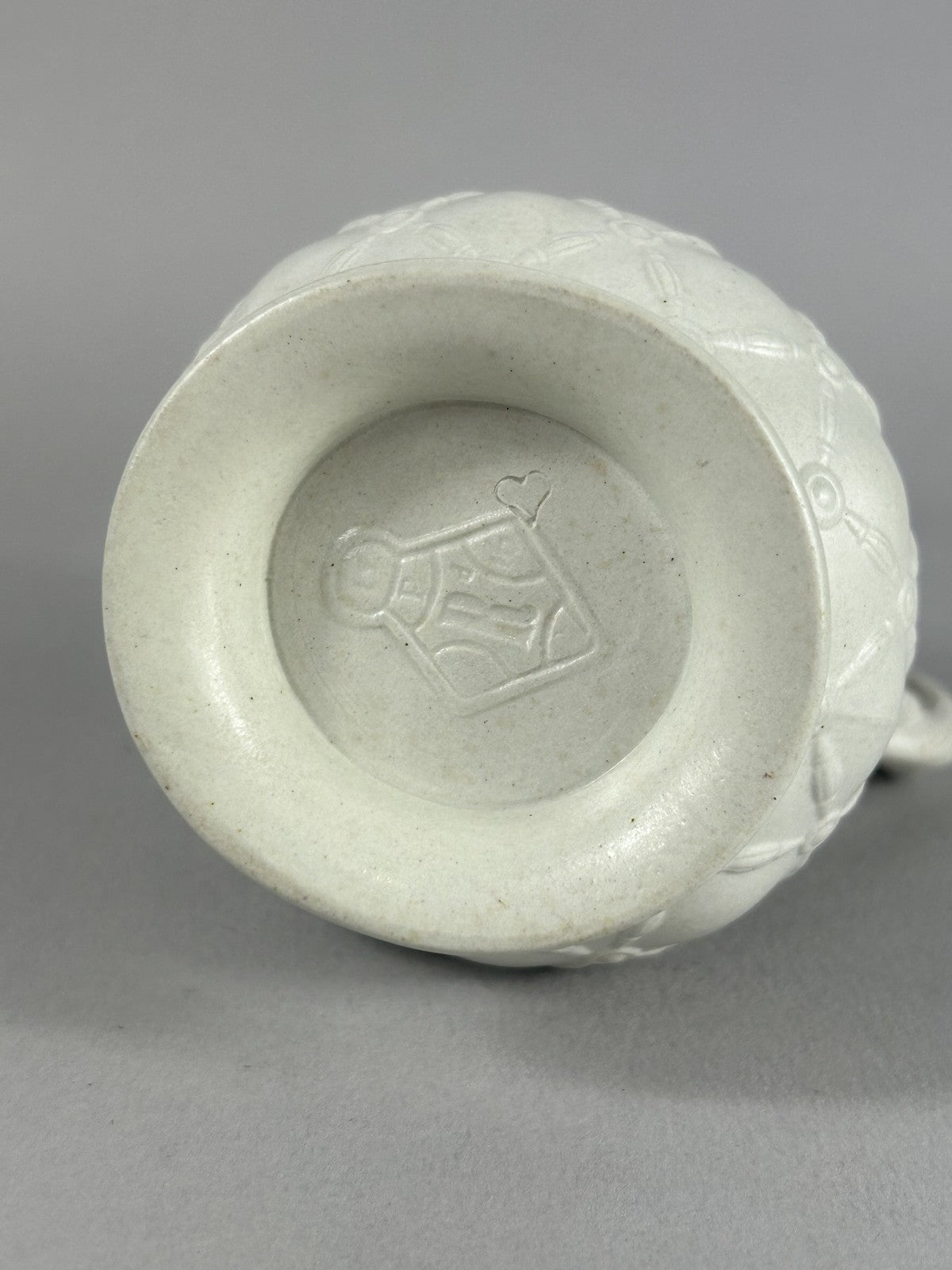
On the underside, the jug bears a moulded impressed mark featuring a heart above a lozenge or shield‑like shape – an emblematic device associated with smaller Staffordshire makers and pattern‑protected designs of the early 1850s. While the exact factory attribution remains a subject for specialist research, the combination of this mark, the material and the pronounced archaeological styling strongly point to a Staffordshire origin rather than to continental manufacture. The mark also underlines the jug’s status as a patented or registered pattern, which contributes to its scarcity today.
Condition appears very good for a piece of this age and finish. The vulnerable high points of the winged bull, rim and hoof‑shaped handle terminal show only minor age‑related wear, with no obvious major cracks, chips or restorations visible in the images. A light, even toning and a few tiny firing specks are consistent with mid‑19th‑century stoneware production and enhance the jug’s period character. Collectors will appreciate the survival of the intricate moulded details, particularly in the wings, beard, tassel cords and pseudo‑cuneiform band.
As a documented example of the Assyrian Revival in British ceramics, this jug offers considerable historical and decorative interest. It encapsulates the Victorian passion for newly uncovered ancient civilisations, translated through the technical capabilities and commercial flair of the Staffordshire potteries. Its compact size makes it ideal for display alongside Parian figures, classical revival pieces or other archaeological‑inspired wares from the Great Exhibition period. For anyone assembling a focused collection of Staffordshire stoneware or 19th‑century Near Eastern revival design, this jug represents a rare and evocative survivor.