Moffitts Antiques
Wedgwood Black Basalt Portrait Medallion No.3 Henry I Kings of England c.1800
Wedgwood Black Basalt Portrait Medallion No.3 Henry I Kings of England c.1800
Couldn't load pickup availability
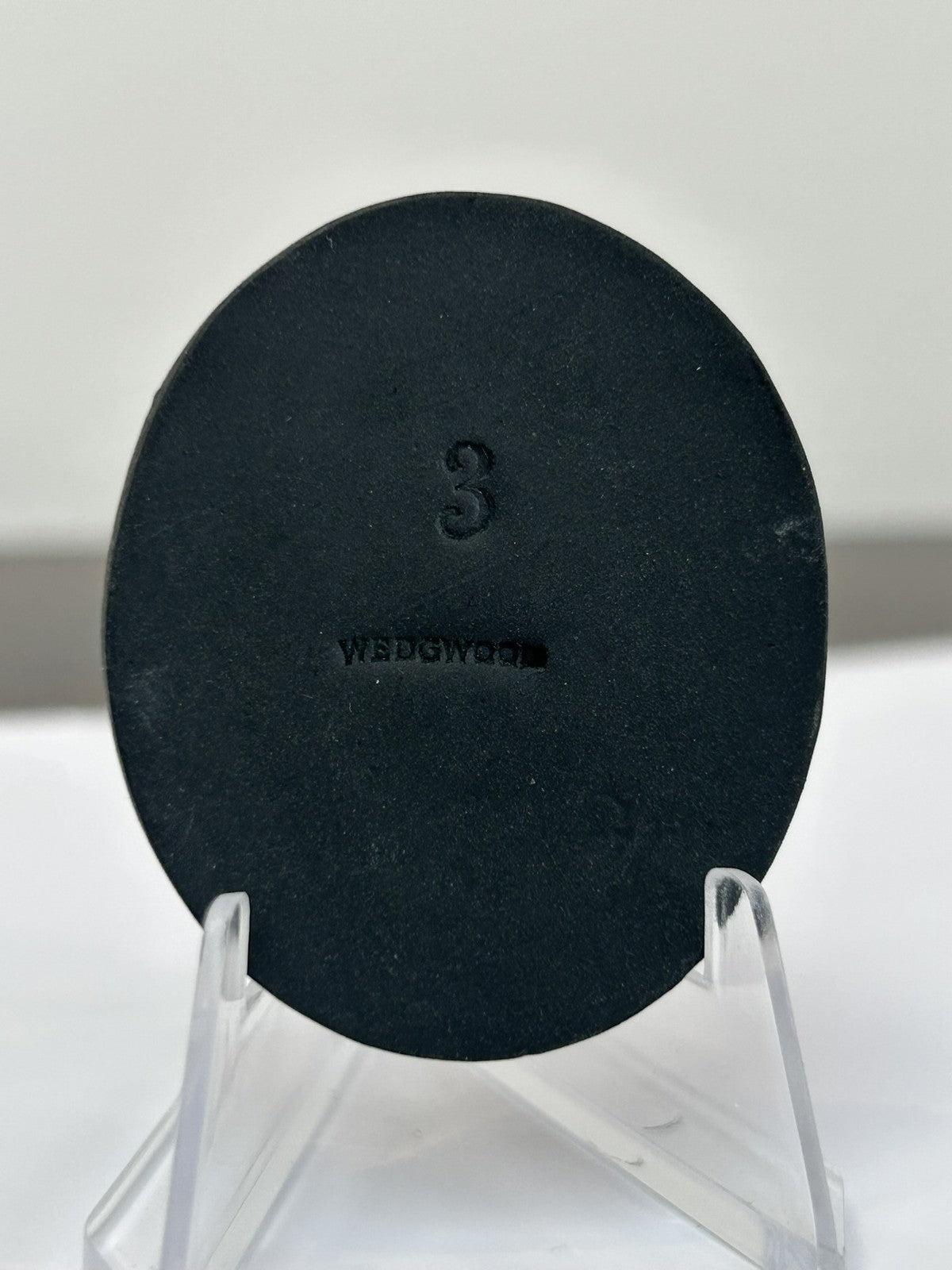
This finely modelled oval portrait medallion is an authentic example of Wedgwood's celebrated 'Kings of England' series, produced in the firm's distinctive black basalt body around 1800. The medallion is impressed with the maker's name WEDGWOOD to the reverse and bears the series number 3, identifying its place within the original sequence.
The 'Kings of England in high relief, including their present Majesties' was first advertised in Wedgwood's 1779 London showroom catalogue. Originally intended as a set of thirty-six medallions covering the English monarchs, the pieces could be purchased as a complete set or individually, and assembled groups are now considered highly collectable in their own right. The standard reference for the series is Robin Reilly's Wedgwood (1998), Vol. 1, p. 478, fig. 685.
The portrait depicts Henry I (reigned 1100–1135). Henry I, the youngest son of William the Conqueror, succeeded his brother William II to become one of the most administratively capable medieval English kings. His reign saw significant legal reforms, including the Charter of Liberties of 1100, often considered a precursor to Magna Carta. The portrait shows him crowned and bearded, in the conventional manner of late Norman royal iconography.
The medallion is sharply modelled in low relief on a smooth oval ground, retaining excellent definition to the features. Wedgwood's black basalt — a refined fine-grained stoneware introduced by Josiah Wedgwood in 1768 — provides a deeply rich and uniform surface, ideally suited to portrait work in the antique manner. Such pieces were prized in the late Georgian and Regency periods as small but serious works of art, designed to be displayed singly in cabinets, set into furniture, or grouped in framed arrangements.
Measuring approximately 4.5 x 4cm, the piece is in very good condition commensurate with its age, with no chips, cracks, or restoration. Light surface wear is consistent with two centuries of careful handling and display. The reverse displays the impressed series number and the single-word WEDGWOOD mark — without the addition of Bentley — confirming production after 1780, following the dissolution of the Wedgwood and Bentley partnership.
Provenance: from the estate of the late Geoffrey and Gina Oxborrow.
An attractive and historically significant piece for collectors of Wedgwood, English ceramics, royal commemorative material, or the late Georgian period. Will be carefully packed and dispatched fully tracked and insured.