Moffitts Antiques
Wedgwood Victorian Blue and Gold Doric Jasperware Jug with Pewter Lid
Wedgwood Victorian Blue and Gold Doric Jasperware Jug with Pewter Lid
Couldn't load pickup availability
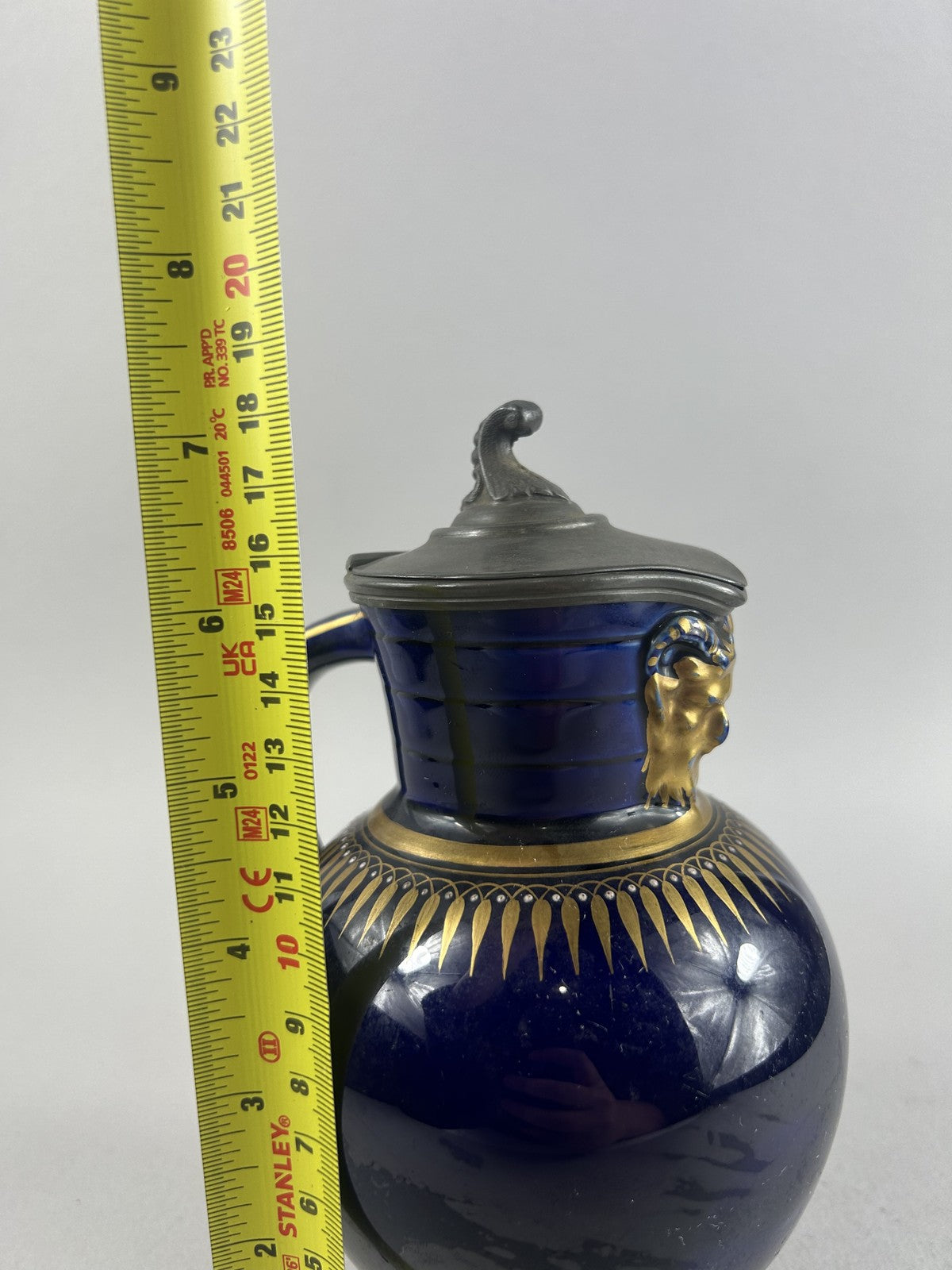
This striking antique jug is a fine example of Wedgwood’s Victorian-period output, combining rich cobalt-blue ground with bold gilt decoration and a fitted metal lid. Standing approximately 18 cm high to the top of the finial, the piece has a well-balanced baluster form rising from a slightly domed circular foot, with a tapered neck and pronounced pouring lip. The overall silhouette and proportions are typical of Wedgwood’s late 19th‑century “Doric” inspired shapes, designed to blend classical simplicity with the richer decorative tastes of the High Victorian era.
The body is finished in a deep, almost inky, blue that reads as a classic Wedgwood “Doric” or midnight ground, highly glossy and reflective. Around the shoulder runs a bold frieze of elongated gilt lappets or tongue motifs, each tipped with a tiny white dot, forming a dramatic sunburst border that visually separates the rounded lower body from the more architectural upper section. The gilt work continues as a fine line to the rim and around the foot, adding definition and an elegant frame to the blue glaze.
The neck is panel-moulded into horizontal bands that give the jug a slightly faceted appearance and help to catch the light on the rich glaze. To one side of the neck, flanking the spout, is a superbly modelled gilt ram’s head mask with curled horns picked out in blue and gold. This classical motif, often associated with Bacchic or neo‑Greek themes, was a favourite in Wedgwood’s Doric range and adds both sculptural interest and a sense of luxury. The handle echoes the neck’s banding, with a gilt line to the outer edge and a zig‑zag or chevron gilded pattern along the spine, showing careful hand‑applied decoration.
The jug is fitted with its original pewter or Britannia metal hinged cover, which is a key feature of many Victorian table jugs intended for ale, cider or hot drinks. The lid is shaped to follow the line of the spout, and is surmounted by a scroll‑form thumbpiece with subtle moulded feathering. The hinge and mount appear well aligned and functional in the photographs, suggesting the cover opens and closes smoothly. The contrast between the soft grey metal and the saturated blue glaze is particularly effective and characteristic of mid‑ to late‑19th‑century taste.
The underside of the base shows the deep blue body material with a slightly recessed centre. Hand‑painted in gold is the pattern or shape number “222”, which is consistent with Wedgwood’s practice of marking decorative pattern codes in gilt numerals during this period. There are also impressed and painted factory marks visible in the photographs, though partially obscured by the glaze and lighting; these would typically confirm the Wedgwood attribution and may allow more precise dating within the Victorian era when examined in person. The edge of the foot shows expected wear from age and use, which helps support its period authenticity.
Condition, from the images and the user’s note, appears very good throughout for a working Victorian jug. The glaze retains a high gloss with only light surface scuffs and minor age‑related rubbing to the gilding in the high‑contact areas, particularly on the handle edge and shoulder, all commensurate with careful domestic use rather than restoration or abuse. The pewter lid shows normal oxidisation and soft patination but no obvious splits or major dents. Importantly, there are no visible cracks, hairlines or significant chips to the ceramic body, making this a particularly attractive and collectible example.
Pieces in this bold blue and gilt Doric style are comparatively scarce compared with Wedgwood’s plainer stonewares and jasper bodies, especially when retaining a complete original metal cover. The combination of classical ram’s head mask, rich colour, and high‑Victorian metalwork makes this jug stand out as both a display piece and a conversation object. It would sit comfortably in a focused Wedgwood collection, an assemblage of Victorian tablewares, or as a single statement accent on a sideboard or mantel. Its moderate 18 cm height also makes it easy to place in a cabinet or on open shelving without dominating the space.
Whether appreciated for its aesthetic qualities, its technical execution, or its place in the history of Wedgwood’s later 19th‑century production, this blue and gilt Doric jug with pewter lid represents a desirable and relatively rare survivor of Victorian design. Its strong condition and classic, richly coloured appearance give it both decorative appeal and good collector interest.